
.
We’ve been in SEO long enough to know that the term “SEO is dead” gets chucked around way too much and far too often. With AI continuing to grow, that term has risen its head once again.
But, once again, no, SEO is not dead and very much alive and kicking. Search volume is at an all-time high, organic clicks still account for the vast majority of traffic Google sends to websites, and the businesses seeing genuine declines are almost always losing ground to specific, fixable problems rather than to AI wiping out search itself.
That said, if you’ve asked this question because your traffic has dropped while your rankings haven’t moved, you’re not imagining things. Things have changed, it’s just not quite in the way most headlines are claiming.
Is SEO Dead in 2026? A Quick Reality Check
- Search volume: growing, not shrinking
- Organic click share: still roughly 90% of all Google Search clicks
- Overall organic traffic: down modestly (around 2.5% year-over-year across large US sites), not collapsing
- Who’s losing ground: mid-tier and low-authority sites relying on broad informational content
- What’s really new: measurement, structure, and off-site trust for AI systems, not a replacement for SEO itself
Why Everyone’s Asking “Is SEO Dead?” in 2026
The “is SEO dead” question resurfaces every few years, usually around a big shift in how people search. This time, the trigger is AI.
Google’s AI Overviews now have more than 2.5 billion monthly active users, and AI Mode has passed a billion users in its first year. At the same time, SparkToro’s 2026 analysis found that fewer than one in three Google searches in the US now ends in a click to any website, with AI Overviews cutting click-through rates by roughly 60% whenever they appear.
Put these trends together and it’s easy to see why many commentators are making the claim that “SEO is dead”. If billions of people are now getting answers without clicking anywhere, why would a business still invest in organic rankings?
What the Data Shows
Here’s where the picture gets more interesting than the headlines suggest. A large-scale study by Graphite, using Similarweb data across more than 40,000 of the largest US websites, found that organic search traffic was down just 2.5% year-over-year, as opposed to the 25–60% collapse widely predicted. The same analysis found that organic results still account for roughly 90% of all clicks generated by Google Search, with paid ads making up the remainder.
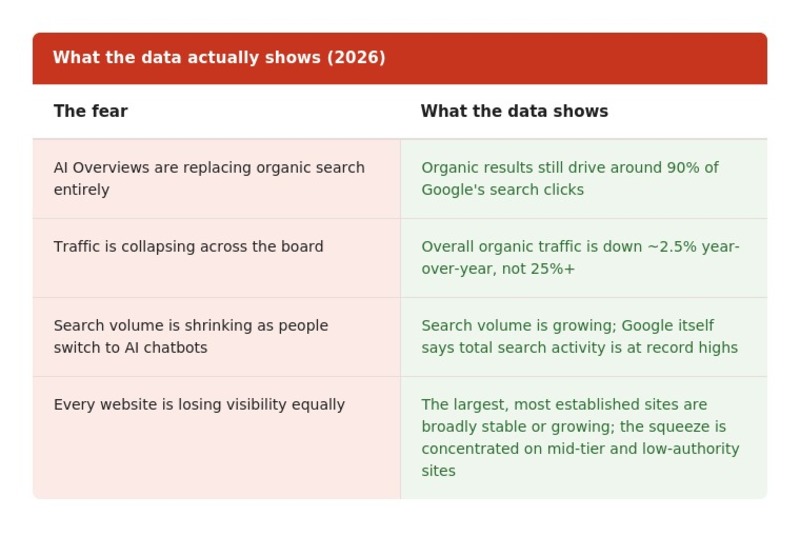
Google has reiterated this, describing total organic click volume as “relatively stable year over year” even as AI features have scaled to billions of users worldwide. Organic clicks are not disappearing; they’re being redistributed.
Why It Feels Like SEO Is Dying, Even Though It Isn’t
Three things are happening at once, and conflating them is what fuels the “SEO is dead” narrative.
Clicks are being compressed, not eliminated
When an AI Overview answers a simple, informational query directly, the click that would have gone to a “what is” or “how to” article often doesn’t happen. That’s a loss for content built purely to capture that kind of search. It doesn’t mean commercial, comparison, or high-intent searches are behaving the same way.
The pain isn’t evenly distributed
The Graphite/Similarweb analysis found that the largest, most established sites grew organic traffic by around 1.6%, while the sharpest declines were concentrated among mid-sized publishers and generic informational content. If your business relies heavily on broad, top-of-funnel blog traffic, you’ll be feeling this shift more acutely than a site with strong brand authority and a more considered buying journey.
Measurement hasn’t caught up
Standard analytics often only count clicks. They don’t capture when your brand is mentioned, cited, or recommended inside an AI-generated answer without anyone clicking through. So a business can be gaining visibility in AI search while its Google Analytics dashboard tells a bleaker story.
So What’s Actually Changing?
SEO isn’t dying, it’s expanding into a discipline that also has to account for how AI systems retrieve, understand, and cite information, alongside how they rank it. Harry, one of boxChilli’s SEO Executives, has gone into more depth in our guide to what AI SEO is, but the short version is this: the fundamentals that have always mattered (technical health, true expertise, clear structure, credible off-site signals) still matter. They’re just not the whole picture anymore.
What’s new is the need to:
- Understand the full-sentence questions people ask AI tools, not just the keywords they type into Google
- Structure content so individual sections can be lifted and cited accurately on their own
- Build the kind of off-site trust signals that AI systems cross-reference when deciding what to cite
- Track visibility in places clicks don’t reach, including Google Search Console’s AI performance reporting and Bing’s AI citation data
The Future of SEO: What to Focus On From Here
The key takeaway for business owners: don’t panic or disengage from SEO services like ours because of a headline. You should, however, ask whether your current strategy still fits how people are searching today.
For marketing leaders already across the latest GEO developments, the priority list looks like this:
- Protect your technical and content fundamentals first. AI visibility is built on the same foundation as traditional rankings, so a technically weak or thin site won’t benefit from any amount of ‘AI optimisation’ layered on top.
- Look beyond clicks when measuring performance. Blend traditional analytics with AI-specific visibility and citation tracking so you can see the full picture.
- Focus commercial content where the click still matters most. Comparison, consideration, and transactional searches are far less exposed to AI Overview impact than broad informational queries.
- Invest in brand and direct search. Searches for your business by name are largely immune to AI Overviews, and they’re a strong signal to Google and AI systems.
- Remember this as evolution, not disruption. The businesses losing the most ground are the ones that haven’t adapted their approach at all, not the ones investing in SEO.
If you want a clearer view of where your own business sits against these shifts, our AI SEO service is built specifically around this blended approach: strengthening the SEO fundamentals while adding the measurement and structure AI search now demands.
Frequently Asked Questions
Is SEO dead because of AI?
No, AI search tools are built on top of the same indexed, crawled web that SEO has always worked to influence. Businesses with strong, white-hat SEO foundations are generally well placed for AI visibility too; those without them struggle in both.
What is the future of SEO?
SEO is broadening into a discipline that also accounts for AI-driven search, sometimes called AI SEO or GEO. The core skills, technical health, genuine expertise, and credible content, remain the foundation, with AI-specific structure and measurement added on top.
Will SEO still matter in 2027, and beyond?
Almost certainly, in some form. Google’s own data shows organic search still drives the overwhelming majority of its click volume, and that isn’t a trend expected to reverse quickly, even as AI features continue to grow.
Should I stop investing in SEO and focus only on AI SEO or GEO?
No. AI-specific work depends entirely on the SEO fundamentals underneath it. Treating them as separate, competing investments is one of the most common and costly mistakes businesses are making at the moment.
If SEO isn’t dead, why has my organic traffic dropped?
It’s worth investigating specific causes rather than assuming AI is solely responsible: algorithm updates, technical issues, content decay, and competitive pressure all still account for a large share of traffic declines. AI Overviews are one contributing factor, but not the only one.
Key Takeaways
- SEO isn’t dead. Search volume is growing, and organic results still account for around 90% of Google’s search clicks.
- Clicks are not vanishing, they’re being redistributed. Clicks are being compressed on simple informational queries, while commercial and comparison searches remain far more resilient.
- The pain is concentrated, not universal. Large, established sites are broadly stable or growing; the sharpest declines are hitting mid-tier and generic informational content.
- Measurement needs to catch up. Clicks alone no longer capture your full search visibility, particularly where AI Overviews and chatbots are involved.
- SEO is evolving, not disappearing. The fundamentals still matter, with AI-specific structure and measurement building on top of them, not replacing them.
If you’re seeing declining traffic and aren’t sure whether it’s AI, a technical issue, or something else entirely, get in touch with us for a straight answer. And if you’d like to understand how we build AI visibility on top of solid SEO foundations, our AI SEO and GEO service page sets out exactly how we approach it.