

.
If you’ve searched for anything relating to marketing recently, you’ve probably come across AI SEO, GEO, AEO or LLMO, and perhaps been confused about what they are and how (and if) they differ. AI SEO, sometimes called AI search optimisation, is the umbrella discipline; GEO, AEO and LLMO are largely overlapping terms used to describe the same underlying work.
That confusion could well be costing you and your business time, and therefore money. Owners and directors are being told search has fundamentally changed and aren’t sure what to act on, while marketing leaders who already understand the theory are stuck on the practical questions: what to actually do, how to measure it, and how to tell a credible agency from following the hype.
In this guide, I will define AI SEO clearly and simply, and show you exactly where traditional SEO ends and AI-search begins. I will also give you a practical framework for deciding what to prioritise, and debunk some common myths.
What Is AI SEO?
AI SEO is: The practice of making your business easy for AI systems, such as Google’s AI Overviews and AI Mode, ChatGPT, Gemini, Perplexity and Copilot, to find, understand, trust and recommend, in addition to ranking well in traditional search results.
AI SEO builds on standard SEO foundations rather than replacing them. It adds a layer of technical structure, citation-ready content, and off-site trust signals designed for how AI systems retrieve and summarise information.
AI SEO exists because search results have developed well beyond the traditional ‘ten blue links’. A growing share of queries now surface an AI-generated summary before the usual list of website links, and a separate, but related, share of research now happens inside conversational tools such as ChatGPT. AI SEO is the work of making sure your business is one of the sources those systems pull from, cite, and recommend.
It’s worth being clear early on about what AI SEO is not. It’s not:
- A replacement for traditional SEO
- A guarantee of a fixed ‘ranking’ inside an AI tool (AI systems don’t produce stable rankings in the way a search engine results page does)
- A set of technical hacks you bolt quickly onto a website.
Instead, it’s closer to a discipline. It’s an extension of good SEO practice, applied to a wider set of interfaces.
Why AI SEO Matters for Your Business Right Now
The scale of the shift is why AI has moved from recreational curio to commercial essential. Independent research tracking Google’s search engine results pages (SERPs) has found AI Overviews now appear on a much greater share of queries, and click-through rates to the traditional organic listings below them fall sharply when they do.
SparkToro’s June 2026 analysis put AI Overview presence at more than one in five Google searches, with click-through dropping by close to 60% on the searches where they appear. Separately, Google has confirmed that its own AI Mode product surpassed a billion monthly users within its first year, with query volume more than doubling every quarter.
None of that means Google or traditional search is going away: UK search share remains inextricably linked with Google, and for anything transactional, local, or urgent, people still default to a conventional search.
What it does mean is that the research and comparison stage of a customer’s journey is increasingly happening inside AI-generated summaries and conversational tools, often before your website is ever visited. If your business isn’t structured to be understood and cited by those systems, you can be doing everything right by traditional SEO standards and still be invisible at these crucial middle-of-the-funnel stages.
It’s no longer only about earning a click, it’s about earning a mention, citation, or recommendation, at a stage of the journey where your competitors may be increasingly showing up, and you might not be.
GEO, AEO, LLMO, and AI SEO: Is There a Difference?
Over the past two to three years, several overlapping terms have entered common use to describe the work of optimising for AI-driven search and answer surfaces. They’re not four separate strategies requiring four separate plans. They’re different names, coined by different commentators, for largely the same body of work, viewed through a slightly different lens.
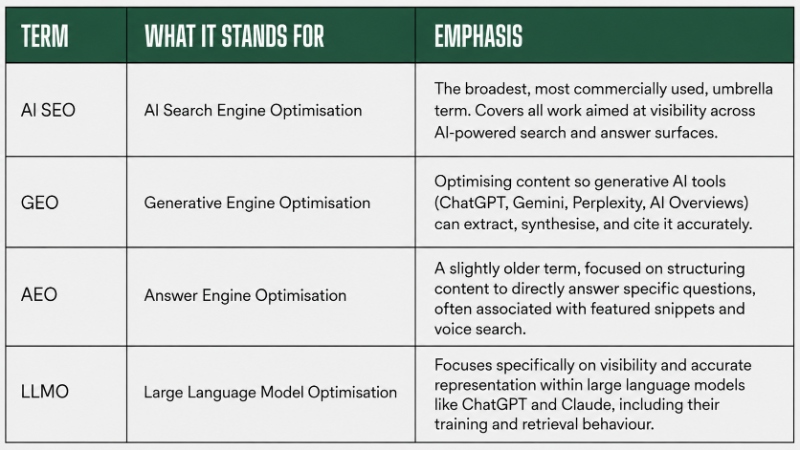
In practice, these terms describe overlapping, not competing, work. A page that’s well structured for GEO (clear headings, self-contained answers, credible sourcing) is, by definition, also doing well at AEO and LLMO, because the underlying requirement is the same: content that’s clear, well-organised, factually-supported, and easy for a machine to extract without losing meaning. Rather than building four separate strategies around four acronyms, it’s more useful to treat AI SEO as the single umbrella discipline.
In Google’s official guidance for website owners, it states plainly that:
“From Google Search’s perspective, optimising for generative AI search is optimising for the search experience, and thus still SEO.”
Google specifically mentions AEO and GEO as terms used to describe that work, rather than distinct disciplines in their own right. We’ve written more on this specific comparison in our SEO vs GEO guide, if you want to go deeper.
Where Traditional SEO Ends and AI-Search Work Begins
This is usually the most practical question business owners and marketing leaders want answered: what do we already have covered, and what’s genuinely new work?
AI systems don’t operate independently of the traditional web. Google’s own generative AI features are built on retrieval-augmented generation (RAG), a technique that pulls from Google’s existing Search index, meaning the same core SEO fundamentals (technical health, content quality, site structure, and backlink authority) remain the foundation everything else is built on. If your standard SEO is weak, no amount of AI-specific tactics will fix that.
Where the additional work begins is in how that content is structured, supported and monitored once the foundations are solid.
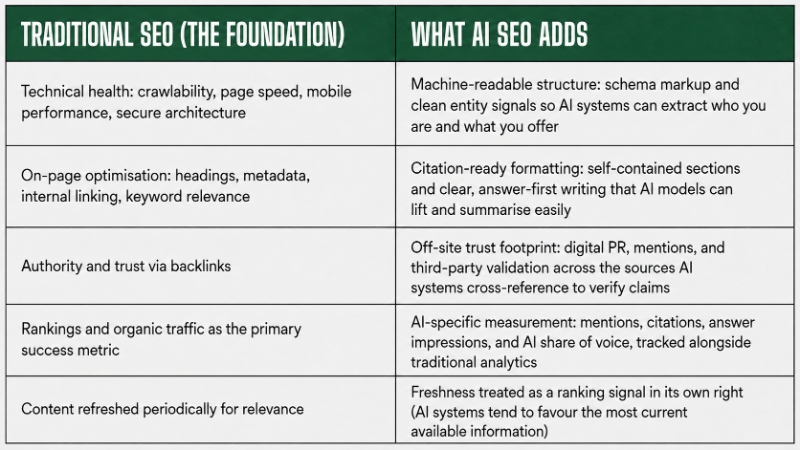
None of the items in the right-hand column work without the left-hand column already being executed well. In short, AI SEO isn’t a replacement service that lets you skip traditional SEO, it’s an additional, complementary layer that only delivers a return once the fundamentals are in place.
How AI Search Decides What to Show
It helps to understand what’s happening behind the scenes; Google has described two techniques underpinning its AI Overviews and AI Mode:
- Retrieval-augmented generation (RAG): this system retrieves current, relevant pages from Google’s live Search index first, then uses that retrieved content to ground its response. This is why strong, indexed, ranking content is crucial.
- Query fan-out: the AI system doesn’t just process your exact search term, but generates a set of related, concurrent queries behind the scenes to gather a fuller picture. A search for “best flooring for a busy hallway” may trigger fan-out queries around durability, cost, and installation, pulling in a wider range of relevant pages than the initial search term suggests.
Large language models such as ChatGPT and Claude work slightly differently, drawing on a mix of training data and, increasingly, live web retrieval when a query calls for current information. What all of these systems share is a reliance on content that’s well-structured, factually-supported and easy to verify against other sources, which is precisely what good AI SEO practice aims to strengthen.
What AI SEO Involves
If your traditional SEO foundation is solid, the additional AI-search work tends to fall into six practical areas.
Prompt and query research
Understanding the questions your customers are asking AI tools, in full-sentence, conversational form, rather than assuming they map neatly onto an existing keyword list.
Building machine-readable structures
Building clear schema markup and consistent entity signals (who you are, what you sell, who your experts are), so AI crawlers can extract accurate information.
Creating citation-ready content
Reorganising your most important pages so each section answers a distinct question clearly and can be lifted and cited on its own, without needing the rest of the page for context.
Developing off-site trust signals
AI systems cross-reference claims against other sources before deciding whether to trust and cite you. If your only evidence for a claim lives on your own website, it carries far less weight than the same claim reinforced by independent mentions, reviews, or press coverage.
Ensuring regular content optimisation
Regularly updating core service pages and pillar content, since AI systems are built to prioritise the most current available information and will favour a recently-updated competitor over a stale, if technically accurate, page.
AI visibility tracking
Monitoring how often, and in what context, your brand appears across AI platforms, then mapping that against your enquiries and conversions.
None of this replaces good content. If anything, it raises the bar, because Google has also been explicit that low-effort content, the kind that repeats common knowledge with no genuine expertise or point of view behind it, performs worse in generative AI search than it does in traditional rankings. First-hand experience, clearly-evidenced claims, and original insights are a measurable advantage.
How to Measure Whether AI SEO Is Working
This is complicated, largely because the metrics that matter for AI search don’t translate cleanly onto a standard SEO or paid media report.
Traditional analytics, GA4 included, can tell you when a visitor arrives having clicked through from ChatGPT or a similar tool, but they can’t tell you when your brand was mentioned, recommended or cited by an AI system without a click ever happening. This is important because a recommendation inside a conversational answer can influence a decision long before someone visits your website.
A workable measurement approach combines several sources:
- Google Search Console’s Generative AI performance report, which shows how your content performs specifically within Google’s AI Overviews and AI Mode.
- Platform-level citation tracking, such as the AI citation performance data Bing has added to Bing Webmaster Tools.
- AI visibility and share-of-voice tools, which prompt-test AI platforms directly to establish how often, and how favourably, your brand appears relative to competitors.
- Traditional analytics, blended in wherever a click does occur, so AI-driven visibility can eventually be connected back to enquiries and revenue.
AI measurement is still an evolving area, and any agency that claims to offer guaranteed ‘ChatGPT rankings’ isn’t to be trusted. Rather, at boxChilli, we improve your probability of discovery, retrieval, citation, and recommendation, built up over time through consistent, evidence-led work.
Common AI SEO Myths, Debunked
Because AI SEO is new and moving quickly, it’s attracted its share of overconfident advice. Here are a few claims worth treating with scepticism, based on Google’s own published guidance:
- “You need an llms.txt file”. Google has stated explicitly that it doesn’t use llms.txt files or similar AI-specific markup for Google Search, including its generative AI features. Creating one won’t harm your site, but it also won’t help your visibility on Google.
- “Content needs to be ‘chunked’ into tiny pieces for AI to understand it”. According to Google, its systems are capable of understanding the nuance of a page and surfacing the relevant section without requiring content to be artificially broken apart. Structure your content for human readers first.
- “You need to chase mentions across as many sites as possible”. Google has been direct that seeking inauthentic mentions isn’t an effective strategy, because its ranking and spam-detection systems are built to recognise and discount exactly that kind of manufactured signal.
- “Structured data is mandatory for AI visibility”. It’s useful, and worth doing well, but Google has confirmed it isn’t a strict requirement for appearing in generative AI features.
Is AI SEO right for Your Business?
For most UK businesses, the answer is yes, but the urgency and the nature of the work depend on what you sell. AI-driven search tends to have the most influence at the research and comparison stage, which makes it particularly relevant for:
- Considered, higher-value purchases, where buyers research and compare carefully before making contact (B2B services, professional services, larger domestic purchases).
- Industries with a strong informational search component, where people are asking “what,” “how”, or “which” questions before they’re ready to enquire (legal, financial, healthcare).
- Businesses already investing in SEO, since AI SEO builds directly on that existing work.
It matters less, at least for now, for urgent, local, or transactional searches, where people still default to a conventional search engine or maps to solve their problem.
If your business fits the first group and your content, structure, and off-site presence aren’t yet built for how AI systems retrieve and cite information, AI SEO can close that gap. At boxChilli, our AI SEO and GEO service starts with a realistic benchmark of where your brand already stands across AI platforms, so you can see what’s worth investing in before committing budget to it.
Frequently Asked Questions
Is GEO replacing traditional SEO?
GEO, and AI SEO more broadly, builds on top of traditional SEO fundamentals. AI systems rely on the same underlying search index and trust signals that traditional rankings depend on, so weak SEO foundations will limit AI visibility just as much as they limit organic rankings.
Do I need a different strategy for GEO, AEO, and LLMO?
No. Treat them as vocabulary describing overlapping parts of the same discipline, as opposed to four separate plans. Content that’s well structured, factually-supported, and easy to extract tends to perform across all three.
How is AI SEO measured?
Through a blend of AI-specific data (Google Search Console’s Generative AI performance report, Bing’s AI citation data, and dedicated AI visibility tools that track mentions and share of voice) alongside traditional analytics. AI systems frequently cite or recommend a brand without generating a click, so it’s important for marketing teams to be across new and traditional metrics.
How long does AI SEO take to show results?
Similar to traditional SEO, it’s a longer-term investment. Technical improvements and clearer citation structure tend to show early progress within the first few months, with more meaningful gains in visibility and enquiries building gradually as off-site trust and topical authority develop.
Can a business do AI SEO without an agency?
Some elements, such as tightening page structure or writing clearer, more self-contained content, can be done in-house. The more technical elements, schema markup at scale, structured off-site trust building, and cross-platform visibility tracking, generally benefit from specialist support.
Key Takeaways
- AI SEO is the umbrella term. GEO, AEO, and LLMO describe overlapping parts of the same discipline, not four separate strategies.
- It builds on SEO, it doesn’t replace it. AI systems rely on the same search index and trust signals traditional SEO already targets.
- AI SEO overlaps with traditional Search optimisation. Machine-readable structures, citation-ready content, off-site trust signals, freshness, and dedicated visibility tracking are what’s distinct from traditional SEO work.
- You need to be across new measurements and metrics. Traffic and rankings alone won’t show you when AI systems mention or recommend your brand without a click.
- Be sceptical of shortcuts. Google has directly debunked several popular ‘AI SEO hacks’, including llms.txt files and content chunking.
- Not every business needs to move at the same pace. AI SEO matters most where research and comparison happen before contact.
Search is broadening, rather than being replaced. The businesses that adapt steadily, by reinforcing strong SEO foundations and adding the AI-specific layer on top, tend to hold their visibility far better than those hastily reacting to headlines and wasting time on empty shortcuts.
If you’d like a clear-sighted view of where your business currently stands across AI Overviews, ChatGPT, Gemini, and the other platforms your customers are using, get in touch with the boxChilli team or find out more about our AI SEO and GEO service.