
.
On 3rd June 2026, Google announced one of the most significant Search Console updates since the launch of AI Overviews, introducing dedicated reporting for generative AI visibility across Google Search and Discover.
For the first time, website owners can see how often their content appears within Google’s AI-powered search experiences, including AI Overviews, AI Mode and AI-driven Discover features.
While the rollout is currently limited to a subset of UK websites, it represents Google’s first meaningful step towards providing dedicated AI search reporting inside Search Console, something the SEO industry has been asking for since AI Overviews first appeared.
What Has Google Added?
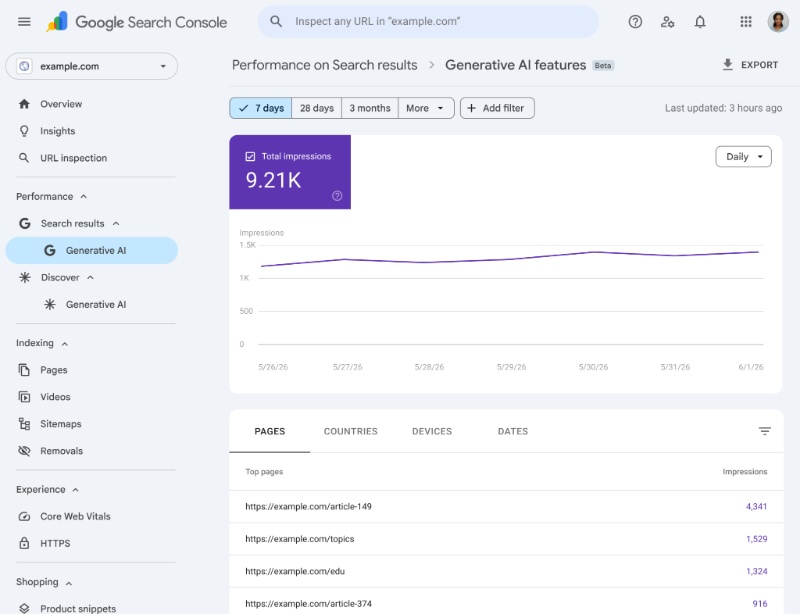
Google has launched new Search Generative AI Performance Reports within Search Console.
Previously, visibility from AI-powered search features was bundled into overall Search Console performance data, making it difficult to understand how much exposure a website was receiving specifically from AI-generated results.
The new reports create a dedicated view focused entirely on generative AI visibility, allowing site owners to isolate and monitor how their content appears across Google’s AI search experiences.
According to Google, the reports are designed to help website owners understand their visibility within:
- AI Overviews
- AI Mode
- AI-powered Discover experiences
This gives businesses a much clearer view of how their content is being surfaced as Google continues to evolve from a traditional search engine into an AI-assisted discovery platform.
What Data Does Google Now Provide?
1. AI Impressions
The headline metric is impressions. Website owners can now see how often URLs from their site appear within Google’s generative AI experiences across Search and Discover.
This provides the first direct indication of whether your content is being selected and surfaced by Google’s AI systems, so for businesses investing in AI SEO, GEO and broader search visibility strategies, this creates an important benchmark for measuring AI exposure.
2. Page-Level Visibility
Google will also show which URLs from your website appeared within AI-generated experiences.
This means you can identify:
- Which pages Google trusts most within AI search
- Which content themes are being surfaced
- Which areas of your website are gaining AI visibility
This is particularly useful for understanding whether informational content, commercial pages or thought leadership assets are contributing to AI visibility.
3. Country-Level and Device Data
The reports include country segmentation, allowing website owners to understand where their AI visibility is occurring geographically. For international businesses, this makes it easier to identify markets where content is gaining traction within AI-powered search experiences.
Google is also providing device-level reporting for Search results.
This allows marketers to understand whether AI visibility is occurring primarily on mobile, desktop or other devices. As search behaviour continues to evolve, this data could become increasingly useful for understanding how users interact with AI-driven experiences across different platforms.
4. Time-Based Reporting
Performance can be analysed over time using:
- Hourly data
- Daily data
- Weekly data
- Monthly data
This makes it possible to monitor visibility trends, track the impact of content updates and identify changes following algorithm updates or shifts in AI search behaviour.
What’s Missing?
While this announcement is significant, there is one notable omission SEOs have picked up on… Click data.
In typical Google fashion (they tend to give us some data, but not all of it), the reports currently focus exclusively on impressions and visibility metrics.
That means, Google is not providing:
- AI-specific clicks
- Click-through rates
- Query-level AI reporting
- Citation-level reporting
- Grounding query data
In practical terms, marketers can now see how often content appears within AI search experiences, but they still cannot see how often users click through from those AI-generated responses.
For now, visibility can be measured, but query-level impact remains largely hidden.
How This Compares to Bing Webmaster Tools
Interestingly, Google’s announcement arrives just a few months after Microsoft introduced AI Performance reporting within Bing Webmaster Tools. While both platforms are now offering dedicated AI visibility reporting, Bing currently provides a deeper level of insight.
Bing’s AI Performance report includes:
- AI citations
- Citation counts
- Grounding queries
- Fan-out query visibility
- Page-level AI references
- Visibility trends
Why This Matters for SEO and GEO
For the last two years, one of the biggest challenges surrounding AI search has been measurement.
Businesses have been investing in content, authority building and AI optimisation strategies without having any truly reliable way to understand whether those efforts were influencing Google’s AI-powered results – if an AI SEO, GEO, AEO or any other acronym agency is telling you that they have the secret weapon to achieving world dominance in AI results, maybe take that with a heavy pinch of salt.
As a result, much of AI SEO and the work we do at boxChilli has relied on:
- Manual testing
- Third-party monitoring platforms
- Prompt sampling
- Visibility estimates
While those tools remain useful, they can only provide directional insights, this update changes that.
For the first time, website owners can access first-party data directly from Google that confirms whether their content is appearing within AI-powered search experiences. That does not mean AI performance is fully measurable yet, because we still lack first-party click and query-level reporting, but it does move the industry a significant step closer to understanding how content performs within Google’s evolving search ecosystem.
Looking Ahead
Google has confirmed that the reports are currently being tested with a limited number of UK websites before a wider rollout. The company has also suggested that additional metrics may be added over time as feedback is gathered from website owners.
Whether click data eventually arrives remains uncertain, but historically, Google has been reluctant to provide detailed reporting around certain AI-generated experiences, which means impressions may remain the primary metric for some time.
Even so, this is arguably the most important Search Console update for AI search visibility since AI Overviews launched.