
.
Your rank tracker says you’re in the top three for the search term that matters most to your business. Meanwhile, a customer asks ChatGPT for a shortlist of suppliers in your sector and gets three names. None of them is yours.
Both things can be true at the same time, which is why measuring AI visibility has become one of the most common (and most frustrating) questions in marketing. Traditional reports were built to track positions and clicks. AI answers don’t have fixed positions, and plenty of the people who see your brand in one will never click.
This guide explains what AI visibility is, how to measure it using the data available today, and how to report it. If you’re a business owner or director, the early sections explain what it means commercially and what to ask for. If you lead marketing, the step-by-step method, metrics, and tooling advice further down are for you.
In short:
- AI visibility is how often, how prominently, and how accurately AI platforms mention, cite, and recommend your brand.
- Rankings don’t measure it. AI answers change from one run to the next, so measure how often you appear across many prompts and repeated runs, not your position in a single answer.
- Use layers of evidence: leading indicators, outcome metrics, diagnostic patterns, and business results such as AI referral traffic and enquiries.
- Combine third-party tracking with first-party data from Google Search Console, Bing Webmaster Tools, and GA4.
- Allow at least 30 days before judging anything, report monthly, and be clear about what can’t be measured.
What Is AI Visibility?
AI visibility is a measure of how often, how prominently, and how accurately your brand appears in AI-generated answers. It covers mentions, citations, and recommendations across platforms such as ChatGPT, Gemini, Claude, Perplexity, Microsoft Copilot, and Google’s AI Overviews and AI Mode.
There are three ways your brand can show up:
- Mentions: your brand is named in the answer, with or without a link.
- Citations: the answer links to, or attributes information to, your website. AI citations are the strongest signal, because they show the platform trusts your content and send people towards you.
- Recommendations: your brand is put forward as a good option for the question asked, such as “the best accountant for a growing construction firm”.
You may also have seen the phrase ‘AI search visibility’. In practice, it means the same thing. Both sit under the wider umbrella of AI SEO, sometimes called generative engine optimisation (GEO), and our SEO vs GEO explainer covers how the terminology fits together.
But visibility isn’t enough on it’s own: if the information AI presents in relation to your brand is wrong, that’s an issue that needs addressing.
Why Rankings and Traffic Don’t Show You AI Visibility
A standard SEO report answers the question ‘where do we rank, and how many people clicked?’. AI visibility asks something different: ‘when someone asks an AI platform about our market, are we part of the answer?’. Three things make that harder to measure:
- There’s no results page. An AI platform gives a synthesised answer that names a handful of businesses. There’s no position on the SERP to track.
- Influence happens without clicks. A recommendation can resonate with someone long before they reach your website, so it won’t appear as a visit in your analytics.
- Answers vary each time. A study by SparkToro and Gumshoe.ai found less than a one-in-100 chance of ChatGPT or Google’s AI returning the same list of brands when the same prompt was repeated. The researchers did find that how often a brand appeared across many runs was far more consistent than its position in any one answer.
That last point is the key to measuring AI visibility properly. Think of it less like a league table and more like an opinion poll. One response tells you almost nothing. A large, consistent sample tells you whether you’re regularly part of the conversation.
The commercial stakes are rising, too. Research from eMarketer found that only 34% of B2B tech marketers feel prepared to execute an AI search strategy, and 51% cite limited internal knowledge as a key barrier. Measurement is where most teams get stuck, and it’s where a clear method gives you an advantage.
The Core AI Visibility Metrics (and How to Calculate Them)
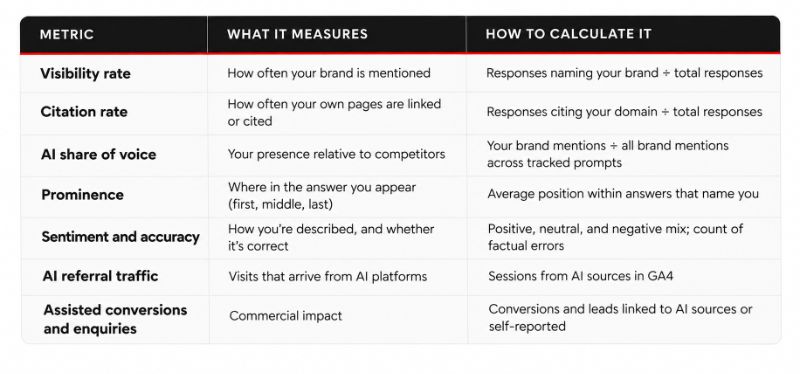
Prompt-level tracking is the foundation of AI visibility tracking, so every metric below is calculated across a fixed set of prompts, run repeatedly across the platforms that matter to your customers.
AI Citations vs Mentions
A mention means the platform named you. A citation means it pointed to your website or content as a source. Track both, but prioritise citations: they’re the clearest evidence your content is being retrieved and trusted, and they’re the visits you can actually follow into your analytics. Look at which of your pages are cited, too. If it’s your blog posts, but never your service pages, that tells you something about where AI platforms see authority.
AI Share of Voice
AI share of voice shows whether you’re gaining or losing ground against competitors, which is why it’s more useful than raw citation counts. A rising citation count means little if the whole category is growing. Here’s an illustrative example, with 40 tracked prompts run 10 times each (400 responses):
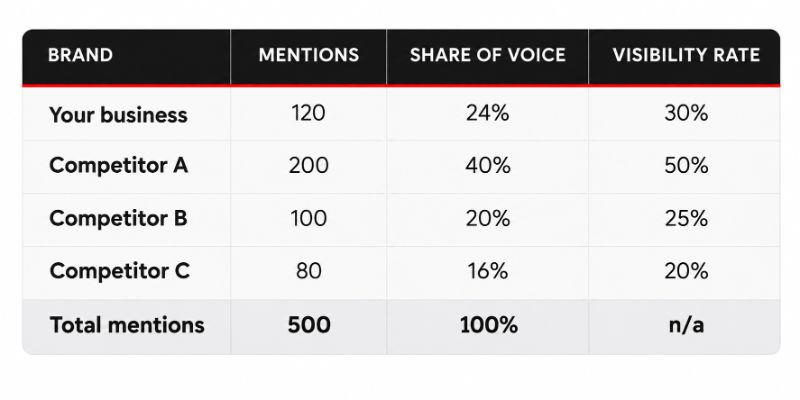
Share of voice divides your mentions by all brand mentions (120 ÷ 500 = 24%), while visibility rate divides them by total responses (120 ÷ 400 = 30%). Rising citations with flat share of voice means the category is growing. Rising share of voice means you’re outpacing the competition.
Sentiment and Accuracy
The most overlooked part of AI visibility measurement is checking what AI platforms actually say about you. Log wrong prices, outdated services, missing locations, and incorrect claims. These errors usually trace back to inconsistent or out-of-date information on your own site and in third-party listings.
A Step-by-Step Approach to AI Visibility Tracking
Step 1: Define the Topics and Prompts
People don’t talk to AI platforms in keywords. They ask full questions, add context, and compare options. Start with three to four topics you want to be known for, then build a prompt set for each. 7 to 10 prompts per topic is a good starting point, which is sensible, as long as you include different phrasings of the same intent.
Source them from sales calls, customer service questions, People Also Ask boxes, Search Console queries phrased as questions, and the comparison questions in your sector. Then group them by intent:
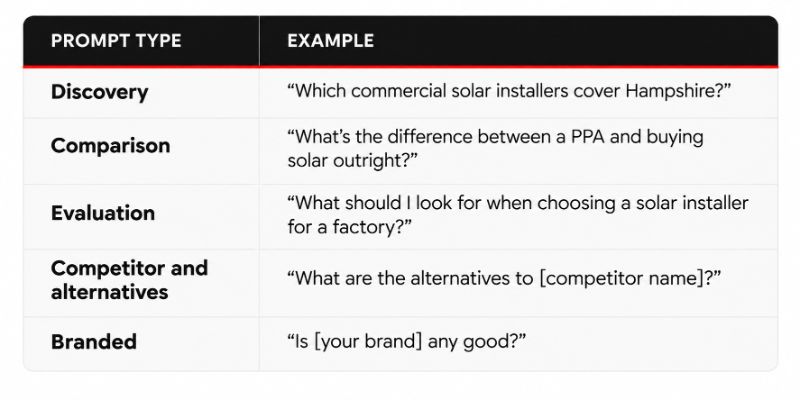
Report branded and unbranded prompts separately. Branded prompts tell you about reputation, whereas unbranded prompts tell you about discovery, which is where you can be getting new customers.
Step 2: Choose Your Platforms
Don’t track everything. Pick the platforms your customers use, using what you know from sales conversations and any AI referrals already showing in your analytics. For most UK businesses that means ChatGPT, Google’s AI Overviews and AI Mode, and Gemini, with Copilot, Perplexity, and Claude added if your audience justifies it. Each platform draws on different sources, so don’t generalise between them.
Also, as there’s no ChatGPT equivalent of Search Console, ChatGPT tracking relies on a blend of methods:
- Prompt sampling: repeating your prompt set, ideally through a tracking tool.
- Referral traffic: visits from ‘chatgpt.com’ in GA4.
- Crawler logs: confirming that OpenAI’s search crawler can reach your pages. Seeing ‘OAI-SearchBot’ in your logs tells you ChatGPT can access your content, but not that it’s recommending you.
- Self-reported attribution: asking new enquiries how they found you.
Our guide on how to get your business found in ChatGPT covers the optimisation side in detail.
Step 3: Set a Baseline With Repeat Testing
Run your prompt set across your chosen platforms and record visibility rate, citation rate, share of voice, and sentiment. Because answers vary, you need repetition. The SparkToro study ran each prompt 60 to 100 times, and a handful of manual spot checks is nowhere near that. Manual checks are still useful for understanding how AI platforms describe you, but they’re not a reporting method.
Record the date, the platform, and the mode (for example, ChatGPT with or without search), then keep the prompt set fixed. Don’t worry too much about movements of a few percentage points.
Step 4: Add First-Party Data
Third-party tools sample and simulate. Platform data comes straight from the source, so use both. Google and Microsoft now offer some first-party AI reporting:
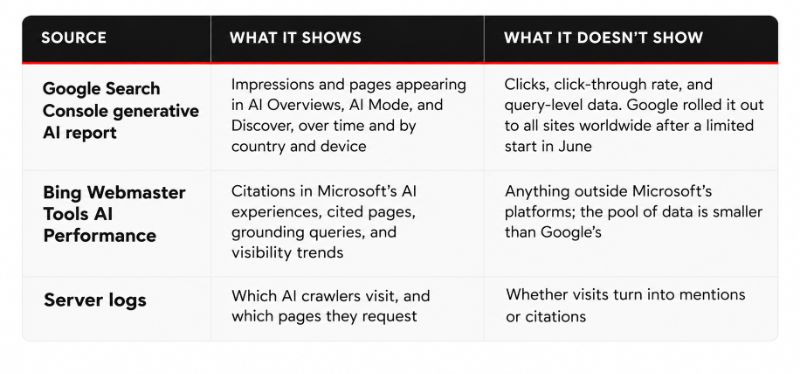
We’ve covered both reports in more detail in our posts on Google’s AI reporting in Search Console and Bing’s AI citation data. It’s worth pulling the pages with the most AI impressions in Search Console and comparing them against the clicks those pages received in the main performance report. A big gap suggests visibility without a compelling enough reason to click.
Step 5: Track AI Referral Traffic in GA4
AI referral traffic is the part of AI visibility you can see in your own analytics:
- Check for the AI Assistant channel. In May 2026, Google added an AI Assistant channel to the default channel group in GA4. It works from the referrer, and Google hasn’t published the full list of platforms it recognises, so check what it captures in your own property.
- Build a custom channel group as a backup. Create a channel that matches source against a pattern such as
chatgpt\.com|chat\.openai\.com|perplexity\.ai|claude\.ai|copilot\.microsoft\.com|gemini\.google\.com, and place it above Referral. Bear in mind that GA4 assigns each session to the first channel it matches. - Know the gaps. Visits from apps, copied links, and some mobile experiences arrive without a referrer and land in Direct. Visits that carry a UTM source but no medium can be found in Unassigned. Clicks from AI Overviews and AI Mode are counted within normal Google organic reporting, not the AI Assistant channel.
- Tag links you control with UTM parameters, such as links in your own AI-powered tools or campaigns.
Step 6: Connect Visibility to Enquiries
This is the step that makes AI visibility reporting relevant to a board. Because so much AI influence happens without a click, you need to capture it another way:
- Add an option such as ‘AI assistant (ChatGPT, Gemini, etc.)’ to the ‘How did you hear about us?’ field on your contact form.
- Ask on sales calls, and record the answer in your CRM.
- Watch branded search and direct traffic for upward movement that coincides with visibility gains.
- Review assisted conversion paths, as well as last-click.
None of this is precise, but together, it builds a credible picture of the route from an AI answer to a conversation with your sales team.
AI SEO Tracking Tools: What to Look For
AI SEO tracking is the wider job of monitoring whether your AI optimisation work is leading to visibility, citations, and enquiries. Several platforms now do the prompt-tracking part, including Semrush’s AI Visibility Toolkit, and they work on broadly the same principle: run your prompts at scale, then report mentions, citations, and sentiment. Here’s what you should be asking before investing in them:
- How many times is each prompt run? A tool that reports from a handful of runs is less relevant. Look for repeated sampling and ranges.
- Which platforms and modes does it cover? ChatGPT with search, Google AI Mode, and AI Overviews can behave very differently.
- Can it be set to the UK? Location and language change answers, especially for local and regional queries.
- Does it capture the cited sources, not just whether your brand name appeared?
- Can you control the prompt set and name your own competitors?
- Can the data be exported and combined with GA4 and CRM data?
- How is any ‘AI visibility score’ calculated? Composite scores differ between tools, so avoid comparing them across platforms.
No tool can see everything: most tracking tools rely on sampled prompts and simulated environments. In other words, they give you a sense of your AI visibility, rather than being definitive.
How to Report AI Visibility
Give It Time
AI visibility shifts rarely happen overnight, but they can happen faster than traditional SEO. Profound’s analysis of around 900 new pages cited by ChatGPT or Claude agents between March and May 2026, found a median of 6.8 days to first citation, with 75% of pages cited within 18.7 days and 90% within 37.1 days. A 30-day window therefore captures most, but not all, early movement, so review at 30 days and again at 60. First citation also isn’t the same as stable visibility, so keep measuring.
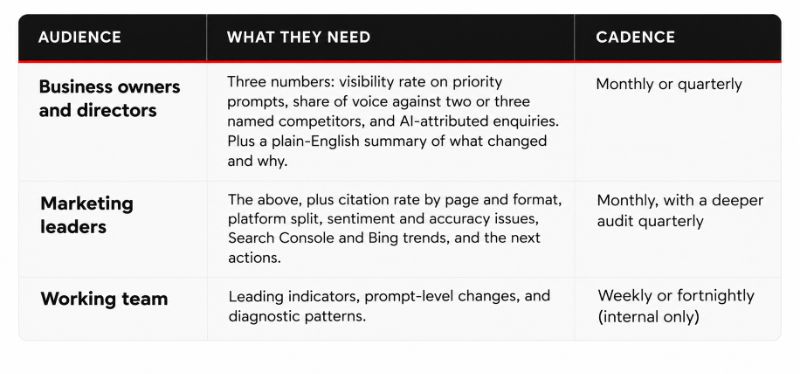
Report on a Sensible Cadence
Mistakes to Avoid
- Chasing position. If rank in an AI answer is unstable, optimising for it is a waste of time. Track frequency.
- Reporting outcome metrics weekly. You may be persuaded to act on changes that are actually a normal variance.
- Looking at citation counts in isolation. Pair them with share of voice.
- Judging an AI visibility initiative too early. Flat numbers early on are likely.
- Treating AI visibility as separate from SEO. AI platforms draw on crawlable, trustworthy, well-structured pages, so weak foundations show up in your results. Our is SEO dead? analysis looks at why SEO and AI search work together.
- Ignoring errors. Wrong information about your business is worth fixing, especially if your visibility numbers are strong. Otherwise, more people are seeing those incorrect details.
Turning AI Visibility Data Into Action
Measurement is only useful if it changes what you do. Diagnostic patterns in your data point towards specific fixes:
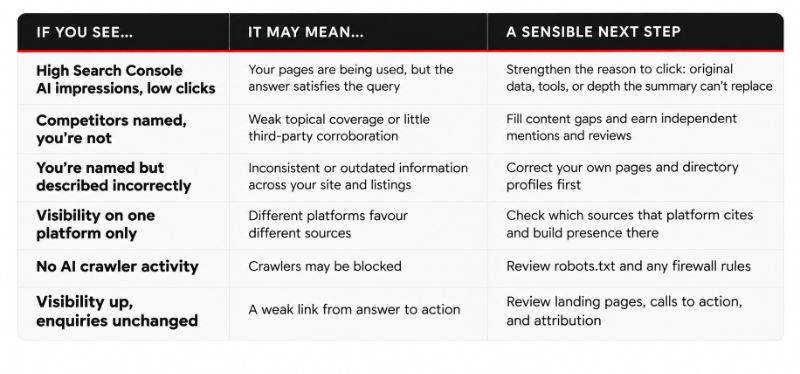
For the optimisation side, our guides on what is AI SEO? and how to get found in ChatGPT will help. Google’s own guidance on creating helpful, reliable, people-first content is a good test for any page you plan to improve, too.
How We Measure AI Visibility at boxChilli
Our AI SEO and GEO service starts with a benchmark: a clear baseline of where your brand currently appears across AI platforms, so any improvement can be measured against it. From there, we track share of voice and citations against named competitors, map that data against analytics so we can follow the route from answer to visit to enquiry, and report monthly with clear explanations of the limits of the data.
If you want to understand where you stand before deciding anything, get in touch with us and we’ll talk you through what an AI visibility review could look like for your business. And if you’re weighing up providers, our guide to choosing an AI SEO agency lists the questions to ask, including how they should be measuring results.
Frequently Asked Questions
What is AI visibility?
AI visibility is how often, how prominently, and how accurately your brand is mentioned, cited, and recommended in AI-generated answers on platforms such as ChatGPT, Gemini, Perplexity, Copilot, and Google’s AI Overviews and AI Mode.
How do I measure AI Search visibility?
Build a fixed set of prompts your customers would ask, test them repeatedly across the platforms that matter, and record visibility rate, citation rate, share of voice, and sentiment. Add first-party data from Search Console, Bing Webmaster Tools, and GA4, then link results to enquiries.
What is AI visibility tracking, and do I need a tool?
AI visibility tracking means monitoring your brand’s presence in AI answers over time. You can run manual checks to get started, but because answers vary so much, a tool that samples prompts repeatedly is the only practical way to get reliable trends.
What is AI SEO tracking?
AI SEO tracking is the wider practice of measuring whether your AI optimisation work is improving visibility, citations, referral traffic, and enquiries. It combines prompt tracking, platform data, analytics, and self-reported attribution rather than relying on rankings alone.
Can I track ChatGPT visibility?
Yes, though not directly through ChatGPT itself. ChatGPT tracking relies on repeated prompt sampling, referral traffic from chatgpt.com in GA4, crawler logs, and asking customers how they found you. Because there are no fixed rankings, track how often you’re mentioned rather than your position.
What is AI share of voice?
AI share of voice is your brand’s mentions divided by all brand mentions across a fixed set of tracked prompts. It shows whether you’re gaining ground on competitors, which citation counts alone can’t tell you.
What are AI citations?
AI citations are instances where an AI platform links to or attributes information to your website. They’re the strongest AI visibility signal because they show your content is being retrieved and trusted, and they can send visitors to your site.
How do I track AI referral traffic?
Use the AI Assistant channel in GA4’s default channel group, back it up with a custom channel group matching AI platform sources, and tag links you control with UTMs. Remember that some AI-influenced visits land in Direct, so treat the total as a minimum.
How long does it take to see changes in AI visibility?
Allow at least 30 days before evaluating a change, then review again at 60. New pages are often cited within weeks, but visibility moves in steps as models and indexes update, so judge trends rather than single data points in isolation.
Key Takeaways
- AI visibility is about presence, not position: measure how often you appear across many prompts and tests.
- Separate your measures: leading indicators, outcome metrics, diagnostics, and business results each answer a different question.
- Track share of voice, not just citations: a rising count means little without competitor context.
- Use first-party data: Search Console, Bing Webmaster Tools, and GA4 add evidence that tracking tools can’t.
- Treat AI referral traffic as a foundation: much of the influence never shows up as a click.
- Check accuracy: what AI platforms say about you matters as much as how often they say it.
- Be patient: allow 30 days, report monthly, and be clear to stakeholders on the limitations of your data.
Not Sure How Visible Your Business Is in AI Search?
AI visibility is measurable, just not in the way traditional SEO reporting works. The businesses that get ahead are the ones that set a baseline early, track the right things consistently, and connect the numbers to enquiries.
If you’d like to know where your business stands across ChatGPT, Gemini, AI Overviews, and the other platforms your customers use, get in touch with the boxChilli team or find out more about our AI SEO and GEO service.