
.
If you’ve started researching AI SEO agencies, you’ve probably noticed the same problem cropping up in every search: everyone claims to do it, and far fewer can actually explain what ‘it’ involves before you sign a contract.
That’s a problem because the stakes are higher than they were with traditional SEO. Get your choice of traditional SEO agency wrong and you waste a few months of budget while rankings stagnate. Get an AI SEO agency wrong and you can end up with a pile of ‘AI-optimised’ content that Google just ignores, a bill for an llms.txt file that might not do as much for your visibility as promised, and no clearer a picture of whether your brand is showing up when customers ask ChatGPT or Google’s AI Overviews for a recommendation.
This guide sets out exactly what to look for in an AI SEO agency, whether you’re a business owner trying to work out if this is worth investing in at all, or a marketing leader who already understands the theory and needs a practical way to separate a credible AI SEO consultancy from one that’s all talk.
But, First, What Does an AI SEO Agency Actually Do?
Harry has written a full explainer on what AI SEO is, but in short: an AI SEO agency (sometimes called a generative SEO agency, AI search agency or GEO agency) helps your business get found, understood, trusted, and recommended by AI systems such as Google’s AI Overviews and AI Mode, ChatGPT, Gemini, Perplexity, and Copilot, in addition to ranking well in traditional search.
This isn’t a separate discipline that replaces traditional SEO. It’s an additional layer, built on top of it, covering things like:
- Researching the full-sentence questions and prompts your customers actually use in AI tools
- Structuring your site so AI crawlers can accurately extract who you are, what you sell and why you’re credible
- Reorganising key pages so each section can be lifted and cited on its own
- Building off-site trust signals AI systems can cross-reference
- Tracking AI-specific visibility metrics that standard analytics don’t capture
Any agency that pitches AI SEO as a standalone service, separate to your existing SEO, is missing the point of how these systems work.
Why Choosing the Right Agency Matters More Than it Used to
The commercial case for getting this right is straightforward. Google’s AI Mode has surpassed a billion monthly users within its first year, and independent tracking from SparkToro puts AI Overviews at more than one in five Google searches, with click-through to organic listings dropping sharply when they appear.
That means a growing share of your customers’ research and comparison stage is happening inside AI-generated summaries, often before they visit your website. If the agency handling this doesn’t understand these mechanics properly, at best you’ll waste budget on tactics that make no measurable difference. At worst, you’ll damage the SEO foundations on which this work depends: Google has been explicit, in its own guidance on creating helpful content, that low-effort, derivative content performs worse in AI-generated search than it does in traditional rankings. An agency chasing shortcuts can leave you worse off.
What to Look for in an AI SEO Agency
Here’s what separates a credible AI SEO consultancy from one that’s just attached ‘AI’ to its existing service list:
It has a traditional SEO foundation
AI systems retrieve their answers from the same underlying search index and trust signals as traditional rankings. If an agency can’t demonstrate solid, technical SEO experience already, its AI-specific work has no foundation. Ask to see traditional SEO results before you get to the AI conversation.
Technical capability, not just content output
Machine-readable structure, schema markup, and clean site architecture are technical jobs. If everything an agency proposes is content-shaped (blog posts, ‘AI-optimised copy’), and nothing involves your site’s technical foundation, that should be questioned.
A measured, evidence-led approach to content
Be wary of anyone pushing content ‘chunking’ as essential, or treating AI-generated copy as a shortcut to authority. Google has stated plainly that its systems don’t require content to be artificially broken apart to be understood, and that first-hand experience and true expertise are a measurable advantage in AI-generated search. The right agency writes for people first and structures for machines second.
A credible approach to measurement
Traditional analytics can’t tell you when your brand is mentioned or recommended inside an AI answer without a click happening. A capable agency should be able to explain how it uses tools such as Google Search Console’s Generative AI performance report and Bing’s AI citation data, alongside dedicated AI visibility and share-of-voice tracking, to build a fuller picture.
Transparent, realistic reporting
You should get a clear point of contact, regular reporting, and honesty about what’s working and what isn’t.
Relevant sector experience
Look for evidence of work in your kind of business, particularly if you sell something considered or high-value, where AI-driven research and comparison tends to matter most.
Straightforward pricing conversations
Reputable agencies will have an open discussion about budget and what level of investment is realistic for your goals.
Questions to Ask Before You Sign
Ask these in a discovery call to see how an agency actually thinks, and whether they’re the right fit for your business:
Red Flags: When to Walk Away
- The promise of guaranteed ChatGPT, Gemini, or AI Overview rankings. These systems don’t produce stable, fixed rankings the way a search engine results page does, so anyone guaranteeing a position is making a promise they can’t keep.
- A pitch built entirely around one tactic, such as an llms.txt file, without addressing the technical and content fundamentals supporting it.
- No mention of traditional SEO. If an agency positions AI SEO as a replacement rather than an extension, that’s a fundamental misunderstanding of how these systems retrieve information.
- Vague or absent reporting. If you can’t get a straight answer on how success will be measured, you won’t get one on whether it’s working.
- Pressure to chase mentions across as many sites as possible, as fast as possible. Google’s ranking and spam-detection systems are built to recognise manufactured signals like this, and it’s a tactic more closely associated with black hat SEO tactics than genuine trust-building.
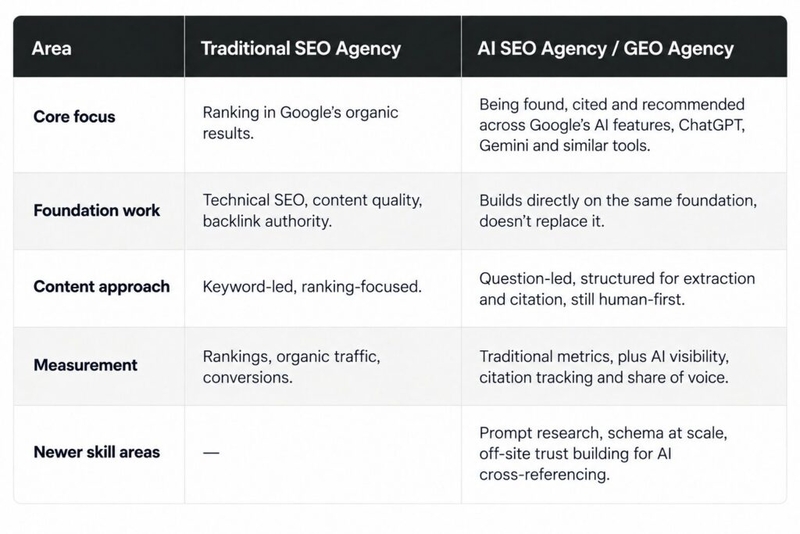
AI SEO Agency vs Traditional SEO Agency: Which Does Your Business Need?
Some of what you need likely overlaps with hiring a traditional SEO agency, and some of it is new. This is worth understanding before you compare quotes:
Is There Such a Thing as a ‘Best’ AI SEO Agency?
Not really, and be sceptical of anyone claiming otherwise. AI SEO is dependent on your sector, your current SEO maturity, the complexity of your buying journey, and your existing website. An agency that’s an excellent fit for an e-commerce brand chasing product visibility may not be the right choice for a B2B professional services firm where the sales cycle is long and the research phase happens almost entirely through comparison and conversation.
Rather than searching for a single “best AI SEO agency,” it’s more useful to look for the best fit: an agency with proven SEO fundamentals, a technically-credible approach to AI-specific work, and direct experience with businesses like yours.
How to Read AI SEO Agency Reviews Properly
Reviews and case studies are useful, but AI SEO is new enough that most reviews won’t yet reference AI-specific results directly. When you’re reading them, look for:
- Evidence of long-term client relationships, not just one-off projects: AI SEO (like traditional SEO) is a longer-term investment
- References to communication and transparency, which tend to be the most reliable predictor of whether an agency will outline problems clearly
- Sector relevance, as well as the volume of five-star reviews
It’s also worth asking a shortlisted agency directly for a client reference in a similar sector, so you can ask about the practical experience of working with them, on top of site testimonials.
Frequently Asked Questions
How do I choose the right SEO agency for AI Search?
Start by checking their traditional SEO track record, since AI SEO only works when built on solid foundations. Then ask how they measure AI-specific visibility, what their view is on common ‘AI SEO hacks’, and whether they can point to relevant sector experience.
How much does an AI SEO consultancy cost?
It varies significantly depending on your website’s current state, your sector’s competitiveness, and the scope of work involved. Be wary of very low-cost, fixed-package offers, since credible AI SEO work usually requires a proper discovery process before pricing can be set accurately.
What should I look for in an SEO agency if I want AI visibility as well as traditional rankings?
Look for an agency that treats AI SEO as an extension of core SEO, so your technical foundation, content strategy, and off-site trust signals are all managed consistently.
Can I do AI SEO in-house instead of hiring an agency?
Some elements, like tightening page structure or writing clearer, self-contained content, can be done in-house. The more technical work, schema markup at scale, structured off-site trust building, and cross-platform visibility tracking can benefit from specialist support.
Is it worth getting a second opinion or AI visibility review before choosing an agency?
Yes. A benchmark of where your brand currently stands across AI platforms gives you a realistic starting point to judge any agency’s proposals against.
Key Takeaways
- AI SEO builds on traditional SEO, so any credible agency needs a track record in the fundamentals first.
- Technical capability matters as well as content, since machine-readable structure and schema work underpin AI visibility.
- Measurement needs to be blended, combining AI-specific tools with traditional analytics, because clicks alone don’t capture AI-driven visibility.
- There’s no single ‘best AI SEO agency’, only the best fit for your sector, buying journey and current SEO maturity.
- Be sceptical of guarantees, single-tactic pitches and vague reporting. These are the clearest signs of an agency following the hype rather than the evidence.
- Ask direct questions before you sign. How an agency answers is often more revealing than what’s on its website.
If you’d like an accurate view of where your business currently stands, and what needs doing before you invest in AI SEO, get in touch with the boxChilli team and we’ll give you a clear, jargon-free assessment. If you want to see the detail behind our approach first, our AI SEO and GEO service page sets out exactly how we work.