
.
If you’ve seen marketers comparing “SEO vs GEO” in a pitch, LinkedIn post, a board meeting, you may be wondering whether it means starting again. In short: it doesn’t.
SEO (search engine optimisation) is about earning visibility and clicks in search results. GEO (generative engine optimisation) is about earning mentions, citations, and recommendations inside AI-generated answers from tools such as Google’s AI Overviews and AI Mode, ChatGPT, Gemini, and Perplexity. For most businesses, they’re not rival strategies: GEO builds on SEO, and weak SEO foundations limit both.
This guide explains the differences, untangles GEO, AEO, and AI SEO, shows where the disciplines overlap, and sets out what to prioritise, how to measure it, and when outside help is worth your marketing budget.
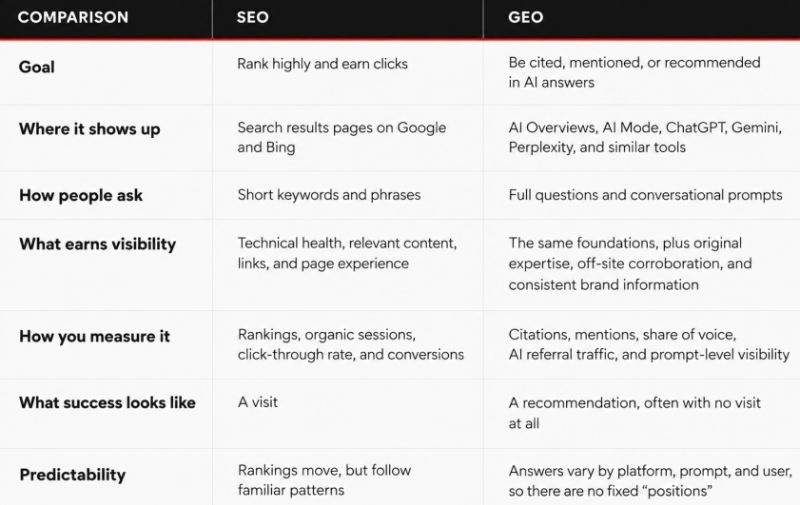
SEO vs GEO at a glance
SEO helps your pages rank and earn clicks. GEO helps AI systems understand, trust, and mention your brand when they answer a question. Both reward clear, credible, useful content, but they appear in different places and are measured differently.
What is SEO?
SEO is the practice of improving your website so search engines can find it, understand it, and show it to people searching for what you offer. It rests on three things working together: technical SEO (a fast, crawlable, mobile-friendly site), on-page optimisation (content, headings, metadata, and internal links that make each page’s purpose clear), and authority and link building (links and mentions from credible sites that signal trust).
All of that is still important, and it’s the base layer that reinforces everything else in this guide. It’s what our SEO service is built around.
What is GEO?
Generative engine optimisation is the practice of making your brand and content easier for AI systems to find, understand, trust, and cite when they generate an answer.
The term was introduced in a 2023 research paper, GEO: Generative Engine Optimisation, by researchers including academics at Princeton University and IIT Delhi, later presented at the KDD 2024 conference. The authors proposed it as a way for content creators to improve their visibility in the responses of generative engines, and reported that some tactics lifted visibility by up to 40% in their controlled tests.
Today the term is used more broadly for any work that helps AI systems represent your business accurately. Rather than competing for one of ten blue links, you’re competing to be one of the sources from which AI pulls, and names.
GEO vs AEO vs AI SEO: what do the terms mean?
The industry hasn’t settled on one name for this work, which confuses things. These are not official standards, the ground appears to be shifting all the time, and different commentators draw the lines in slightly different places, but this is how the terms are most commonly used:
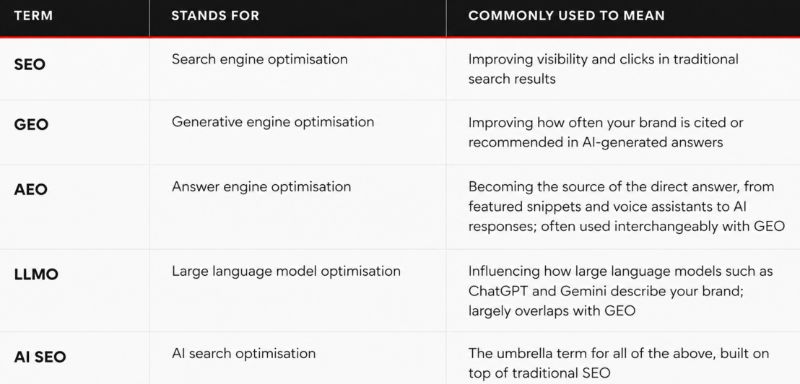
Google’s own guidance for site owners recognises AEO and GEO as terms for work aimed at AI search visibility, but says that from its perspective, optimising for generative AI search is still SEO. It also advises evaluating any third-party ‘AEO’ or ‘GEO’ advice in relation to its official guidance and its advice on third-party SEO services.
GEO vs AEO
GEO and AEO describe heavily overlapping work, and most agencies use the terms interchangeably. AEO is the older term, rooted in winning featured snippets and voice answers. GEO is the newer one, focused on generative AI responses and on whether your brand is cited or recommended. If you do one properly, you’re doing most of the other.
AEO vs SEO
SEO aims to rank your pages. AEO aims to have your content used as the answer itself. In practice, AEO is a specialised part of good SEO: question-led headings, direct answers, accurate facts, and well-organised pages have been winning snippets for years. The difference is the destination, which is a sentence in a response rather than a position on a results page.
AI SEO vs GEO
AI SEO is the umbrella and GEO is a core part of it. We refer to “AI SEO” as the whole job, meaning strong SEO foundations plus AI-specific work such as prompt research, citation-ready content, off-site trust signals, and AI visibility tracking, with “GEO” being the specific goal of being cited and recommended by generative engines. Our guide to what is AI SEO covers the full picture.
Where SEO and GEO overlap
Google’s AI Overviews and AI Mode are rooted in its core search systems. They use retrieval-augmented generation, which pulls relevant, up-to-date pages from Google’s Search index to ground each answer, and query fan-out, which runs related searches in the background to gather more detail. For a page to appear in these features, it must be indexed and eligible to be shown in Google Search with a snippet.
Other assistants, such as ChatGPT, Perplexity, and Gemini, source and weigh information differently, and their behaviour changes often. However, they all lean on content that is clear, well supported, and easy to verify elsewhere. That’s why the same foundations pay off everywhere:
- A site that search engines can crawl and index
- Helpful, original content written for humans
- Clear structure, with descriptive headings and direct answers
- Credible signals, such as links, reviews, and mentions from trusted sources
Where GEO goes beyond SEO
Strong SEO gets you into the conversation, but these are the areas where GEO asks for something extra:
- Prompt research, not just keyword research: People ask AI tools full questions, such as “what should I look for in a payroll provider for 50 staff?”, and ask follow-ups. Understanding those prompts should shape what you publish.
- Off-site corroboration: Claims that appear on your site and are echoed by credible third parties, such as reviews, trade press, industry directories, and relevant community discussion, carry more weight than claims that appear only on your own pages. This has to be earned: Google is clear that chasing inauthentic mentions isn’t effective.
- Content only you could write: A page that restates what every other page says gives an AI nothing distinctive to cite. Original data, first-hand experience, and a clear point of view do.
- Consistent business information: Your services, locations, and expert profiles should match across your website, Google Business Profile, and directory listings. Google notes that business profiles and Merchant Center product feeds can feed into AI responses where relevant.
- Measurement beyond clicks: Visibility inside an AI answer doesn’t always produce a visit, so reporting needs to cover more than rankings and sessions.
Why this matters for your business
For business owners and directors, the crucial question is whether customers can find and trust you at the point they’re deciding. Three facts provide useful context:
- Fewer searches end in a click: SparkToro’s analysis of Similarweb data found 69.5% of Google searches in the UK between January and April 2026 ended without a click of any kind, compared with 68% in the US.
- AI answers are part of the reason: SparkToro’s US research, citing Ahrefs data, puts AI Overviews on more than 20% of searches, with click-through rates falling by nearly 60% when one appears.
- AI tools don’t send much traffic yet: The same report notes that AI tools send out less than 1% of all traffic.
Taken together, GEO today is mostly about influence at the research and comparison stage (when buyers are forming a shortlist), rather than a new traffic channel. It’s also not a reason to abandon organic search, which still drives the large majority of Google’s clicks (we dig into the data more in our Is SEO Dead? blog). Treat GEO as an extension of your SEO investment.
Do you need to choose between SEO and GEO?
No, but the better question is what to do first. Here’s how we’d think about it:
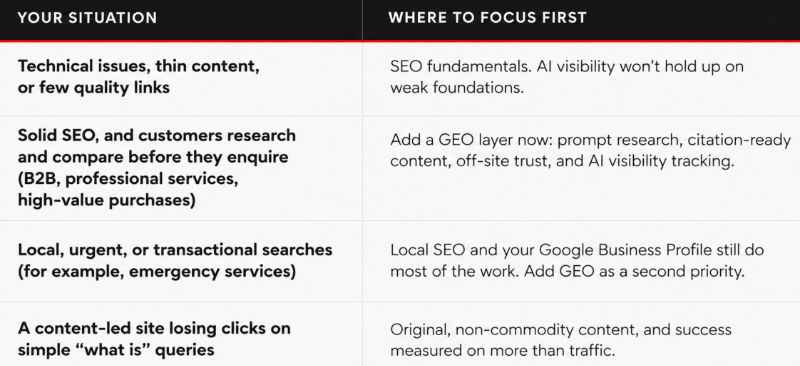
If you’re not sure which row describes you, get in touch and we’ll give you a straightforward view.
SEO for AI: what to do in practice
Whatever you call it, the practical work is mostly the same. Drawing on Google’s published guidance and our own experience, this is where we’d start:
- Get the technical basics right. Pages need to be crawlable, indexed, and eligible to appear with a snippet. Fix crawl errors, duplicate content, and slow or awkward pages first.
- Publish content only you could write. Google says unique, non-commodity content is likely to influence your presence in AI search more than any other tactic in its guide. Original data, first-hand experience, and expert commentary all count. Google’s guidance on helpful, reliable, people-first content is the benchmark.
- Answer real questions clearly. Use research into how your customers phrase questions, then answer them directly under descriptive headings. Write for readers first; there’s no need to write in a special way for AI.
- Back up your claims: Cite credible sources, state facts precisely, and name the experts behind your advice.
- Use structured data accurately: It isn’t required for AI features, but it keeps machine-readable facts about your organisation, content, and products correct and supports rich results in Search Engine Results Pages (SERPs).
- Build relevant off-site trust: Reviews, trade press, partnerships, and community conversations that reflect real customers and real experience.
- Keep business details consistent and current: That covers your Google Business Profile, product feeds if you sell online, directory listings, and key pages that carry prices, stats, or service details.
What you can skip:
- Llms.txt files: Google says Search doesn’t use them, so creating one neither helps nor harms your visibility there. We cover this in our Does your website really need an llms.txt file? blog.
- Chopping content into tiny fragments: Google says its systems can understand multiple topics on one page, so structure pages for readers, first and foremost.
- Manufactured mentions: Seeking inauthentic mentions across the web isn’t as helpful as it might seem.
- A separate page for every prompt variation: Google warns that doing this mainly to manipulate AI responses can breach its scaled content abuse spam policy.
How to measure SEO and GEO
You need both sets of numbers, but a brand can gain visibility in AI answers while analytics show flat or falling clicks. These are the places to look:
- Google Search Console: The Generative AI performance report shows how your content performs in Google’s AI features.
- Bing Webmaster Tools: Bing now reports AI citation performance data.
- GA4: Traffic from AI platforms where people do click through.
- AI visibility tools: These prompt-test AI platforms to show how often, and how favourably, your brand appears against competitors. But, remember, Google cautions that no third-party tool has access to its internal ranking or AI systems.
- Commercial signals: Branded search, direct visits, enquiry quality, and “how did you hear about us?” answers.
Be sceptical of anyone promising guaranteed ‘ChatGPT rankings’. AI answers vary by prompt, platform, and user, so the realistic goal is to improve the probability of being found, cited, and recommended over time.
Questions to ask before hiring an agency
If you’re weighing up outside support, a few questions separate substance from hype:
- Do they start with your SEO foundations, or sell GEO as a shortcut?
- Will they benchmark where your brand appears in AI platforms today, so progress can be measured?
- How will they report on visibility that doesn’t generate clicks, and do they avoid guarantees?
- Can they explain what they would skip, such as llms.txt or artificial chunking, and why?
- Is their off-site work built on genuine PR and reviews rather than manufactured mentions?
Our guide on how to choose an AI SEO agency goes into more detail.
The boxChilli view

We’ve been helping businesses through changes in Search since 2006, from Panda and Penguin to mobile-first indexing and Core Web Vitals. AI search is the latest shift, but our perspective remains consistent: the businesses that do well keep their fundamentals strong and adapt to how people find information.
That’s why our AI SEO and GEO service builds on proven SEO foundations. It starts with a benchmark of where your brand appears across AI Overviews, ChatGPT, Gemini, and other platforms, then covers prompt research, machine-readable structure, citation-ready content, off-site trust signals, and AI visibility tracking, delivered by an in-house team of more than 30 specialists.
If you’d like a clear view of where your business stands, get in touch with us.
Frequently Asked Questions
What is the main difference between SEO and GEO?
SEO aims to rank your pages and earn clicks in search results. GEO aims to get your brand cited, mentioned, or recommended in AI-generated answers. They share the same foundations, but they are measured and optimised in different ways.
Is GEO replacing SEO?
No, Google’s AI features draw on its core Search systems, and a page must be indexed and eligible to appear in Search to be shown in them. GEO builds on SEO, rather than replacing it.
Are GEO, AEO, and AI SEO the same thing?
Largely, yes. GEO and AEO overlap heavily and are often used interchangeably, with AEO traditionally focused on winning direct answers and GEO on generative AI responses. AI SEO is the broader umbrella that includes both, alongside traditional SEO.
Do I need GEO if my SEO is already strong?
Strong SEO gives you a head start, but it doesn’t tell you whether AI tools mention your brand. If your customers research and compare before they enquire, it’s worth benchmarking your AI visibility and closing any gaps.
Do I need an llms.txt file or special schema for GEO?
Not for Google Search. Google says it doesn’t use llms.txt files, and that structured data isn’t required for its generative AI features, although structured data is still worth using for rich results.
Is GEO the same as geo-targeting or local SEO?
No. In this context, GEO means generative engine optimisation. Geo-targeting and local SEO relate to location. Local SEO still matters, particularly your Google Business Profile, which can also feed into Google’s AI responses.
Key takeaways
- SEO earns rankings and clicks. GEO earns citations, mentions, and recommendations in AI answers.
- GEO builds on SEO. Weak foundations limit visibility in both.
- GEO, AEO, and LLMO overlap heavily. AI SEO is the umbrella term for the whole discipline.
- Original, well-evidenced content matters more than any technical trick. You can skip llms.txt, artificial chunking, and manufactured mentions.
- Measure beyond clicks, and be sceptical of guarantees.