
.
Ask ChatGPT who the best supplier, agency, or specialist in your sector is, and you won’t get ten blue links. You’ll get a short, confident list of recommendations. Your business is either on it or it isn’t, and the customer may never visit a search results page to find out.
That is the commercial reality behind ChatGPT SEO: the work of making your business easy for ChatGPT to find, understand, trust, and recommend, so you get found in ChatGPT in the key moments your customers are researching and comparing options.
The term is also used to mean something quite different, which is why the search results for it are such a mixed bag. ChatGPT SEO can mean:
- Getting your business found in ChatGPT: improving how often, and how accurately, ChatGPT mentions, cites, and recommends your brand.
- Using ChatGPT to do your SEO: handing keyword research, content, and technical work to an AI tool, usually to save time or money.
This guide covers both. If you’re a business owner who wants to understand what this means commercially, the first sections explain why ChatGPT visibility matters and how it works. If you’re a marketing leader, the practical steps, measurement advice, and agency questions further down are for you. And if you’re wondering whether ChatGPT can replace your SEO budget, we’ll answer that, too.
In short:
- ChatGPT doesn’t have fixed rankings. You’re aiming to improve the probability that your business is retrieved, cited, and recommended.
- ChatGPT optimisation builds on strong SEO foundations; it doesn’t replace them.
- The most reliable levers are letting OpenAI’s search crawler in, publishing content worth citing, making your business easy to understand, and earning trust beyond your own website.
- ChatGPT is a good SEO assistant, but a poor SEO strategist. Shortcuts tend to cost more than they save.
What Is ChatGPT SEO?
ChatGPT SEO is the practice of improving how often, and how accurately, ChatGPT finds, mentions, cites, and recommends your business, in addition to ranking well in traditional search results.
It sits under the wider umbrella of AI SEO, sometimes called generative engine optimisation (GEO). If you want the bigger picture, our guide to what is AI SEO and our SEO vs GEO explainer cover the terminology in detail. For this article, all you need to know is that the work overlaps heavily with good SEO, with a few important differences:
- There’s no results page: ChatGPT gives a synthesised answer, usually naming a handful of businesses, rather than a list of ten links from which to choose.
- There’s no fixed position: Answers vary with the wording of the question, the person asking, and the date, so you can’t simply ‘rank third’. Success is measured in mentions, citations, and recommendations across many prompts.
- Visibility can happen without a click: A recommendation inside an answer can shape a decision long before anyone reaches your website.
Why ChatGPT Visibility Matters for Your Business
Customers increasingly use tools like ChatGPT to research and compare before they contact anyone. They ask questions like “Which accountant is best for a growing construction firm?” or “What should I look for in a commercial solar installer?”, and they act on the answer.
There are three commercial implications:
- Shortlists form earlier: By the time someone visits your website or picks up the phone, they may already have narrowed their options to two or three suppliers.
- Recommendations carry weight without a click: A mention in an answer can influence a decision even when it never appears as a visit in your analytics.
- There are fewer slots: A results page can show a customer ten competitors. A conversational answer may name three.
None of this means Google is going away. For urgent, local, and transactional searches, people still default to a conventional search engine; ChatGPT is merely one of several places where discovery now happens. As you’ll see on our is SEO Dead? What the Data Shows in 2026 page, the evidence shows this clearly.
ChatGPT visibility matters most for considered, higher-value purchases, where buyers research and compare carefully before getting in touch: B2B, corporate and professional services, healthcare, hospitality, and larger domestic purchases, for example.
How ChatGPT Decides Which Businesses to Recommend
OpenAI doesn’t publish a ranking formula, so be wary of anyone who claims to know ChatGPT’s exact ‘ranking factors’. What we can say, based on OpenAI’s documentation, Google’s published guidance on generative AI search, and our own client work, is that ChatGPT draws on two broad sources of information.
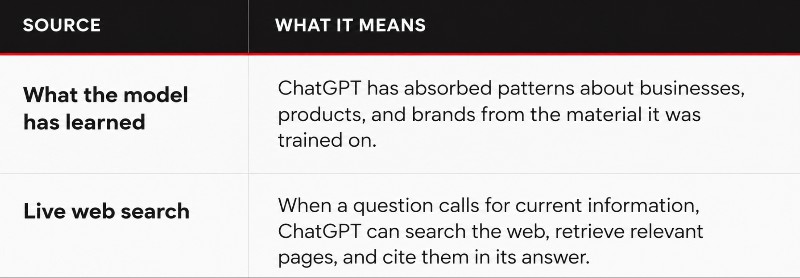
Broadly, ChatGPT’s search features work on a similar principle to Google’s AI features: retrieve relevant pages first, then summarise and cite them. That’s why the foundations matter so much. If a page can’t be crawled, understood, or trusted, there’s little for ChatGPT to retrieve. In both cases, the system is looking for information that is clear, consistent, and corroborated. That’s why the steps below focus on your whole digital footprint.
How to Rank in ChatGPT: Seven Practical Steps
Step 1: Let ChatGPT’s crawlers in
It sounds obvious, but blocked crawlers are one of the most common reasons a business can’t appear in ChatGPT’s search results. OpenAI lists four user agents, each with a different job. Only one of them, OAI-SearchBot, controls whether you appear in ChatGPT’s search answers:
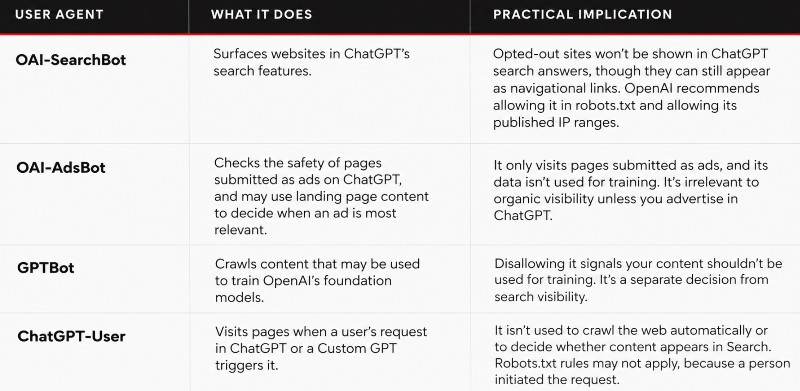
OpenAI says each setting is independent, so you can allow OAI-SearchBot to appear in search while disallowing GPTBot. If you allow both, it may use the results of one crawl for both purposes.
Check your robots.txt file, and make sure no firewall, CDN, or bot-protection tool is blocking OpenAI’s published IP ranges. OpenAI notes that robots.txt changes can take around 24 hours to take effect for search. If your developers blocked AI bots wholesale in the past, it’s worth revisiting that decision with a clear view of the implications.
Step 2: Get your SEO foundations right
This is the step you may want to skip, but it’s the one that most often decides the outcome. Pages need to be crawlable, indexable, fast, and well-organised, with clear site architecture and authority behind them. Google is explicit that optimising for generative AI search is still SEO. That guidance is written for Google, not ChatGPT, but the principle is transferable: there’s no reason why a weak, hard-to-crawl website would be recommended by any retrieval system.
In other words, if your SEO has gaps, fix those first.
Step 3: Research the prompts your customers use
People don’t talk to ChatGPT in keywords. They ask full questions, add context, and compare options, such as: “Which IT support company in Hampshire is best for a 40-person law firm?” Keyword lists don’t capture that, so start with considering the real language of your customers:
- Questions your sales and customer service teams hear every week.
- Search Console queries that are already phrased as questions.
- The comparison, pricing, and ‘best for’ questions in your sector.
- Modifiers that change the answer: location, budget, company size, and use case.
Group these by buying journey stage, then check what ChatGPT currently says for each. Fill the gap between what customers ask and what your website answers with a content roadmap.
Step 4: Create content worth citing
This is a crucial step. A cited page usually does three things well: it answers the question directly, says something specific, and is clearly credible.
- Lead with the answer: Put a clear, self-contained answer directly under each heading, then expand. Write for human readers first. Google has confirmed there’s no need to chop content into tiny pieces for AI.
- Be specific and original: Google calls generic, widely available material “commodity content” and says unique, expert-led content is the biggest long-term lever for visibility in AI search. Original data, first-hand case studies, and named experts give ChatGPT something it can’t get elsewhere.
- Cover the decision-stage pages: Comparison pages, pricing explanations, ‘how to choose’ guides, and rigorous FAQs are exactly what ChatGPT reaches for when answering ‘which is best?’ questions.
Step 5: Make your business easy to understand
ChatGPT can only recommend what it can describe accurately. Make sure your name, services, locations, and credentials are stated clearly and consistently across your website, Google Business Profile, LinkedIn, and any directories in which you appear. Back it up with a strong About page, named team members, and official proof such as awards, accreditations, and case studies.
Structured data helps here. Schema markup for your organisation, services, people, and articles gives machines an unambiguous summary of who you are and what you do, and schema.org is the shared vocabulary for it. Structured data isn’t a requirement for generative AI features, however, and there’s no special markup that guarantees a mention.
Step 6: Build trust beyond your own website
ChatGPT, like any system trying to avoid being wrong, is more confident in claims that are corroborated. If the only place your expertise is described is your own website, it carries less weight than the same claims backed up by independent sources. You should:
- Encourage real reviews on the platforms your customers use.
- Earn coverage and links through digital PR, industry bodies, and trade publications.
- Keep your presence accurate in respected directories.
- Take part in the communities and forums where your customers ask questions.
The operative word is real: Google has been clear that chasing inauthentic mentions isn’t effective, and the same logic applies to any system built to spot manufactured signals.
Step 7: Keep content fresh and keep testing
AI systems are built to avoid serving stale information, so a recently-updated, accurate page tends to be a better candidate than an out-of-date one. Review your most important pages on a regular schedule, update facts, prices, and examples when they change, and only refresh dates when the content has evidently been improved.
Next, test. Re-run your priority prompts, see which businesses are being recommended, and look at what they have that you don’t, such as deeper content, stronger reviews, better press coverage, or clearer pages. ChatGPT optimisation is an ongoing process.
These seven steps are the backbone of our own AI SEO and GEO service, which combines prompt research, a baseline visibility benchmark, machine-readable site structure, citation-ready content, off-site trust building, and ongoing tracking, all built on proven SEO foundations.
Shortcuts That Don’t Work
Because this area is new and moving fast, it has attracted plenty of overconfident advice. Treat the following with scepticism:
- Guaranteed ChatGPT rankings. Answers vary by person, wording, and time, so nobody can guarantee a position. Any agency or tool promising one isn’t to be trusted.
- Mass-produced AI content. Publishing hundreds of near-identical pages to cover every possible prompt can fall foul of Google’s scaled content abuse policy, and it gives ChatGPT nothing distinctive to cite.
- Manufactured mentions and hidden manipulation. Fake reviews, planted forum posts, and hidden text aimed at AI tools are the next chapter in a long history of black hat SEO tactics. They put your reputation at risk for short-lived gains.
- Treating it as a separate discipline. A business with weak SEO foundations and a ChatGPT-specific plan on top will be disappointed.
Can You Use ChatGPT to Do Your Own SEO?
The other half of ChatGPT SEO is the question of whether you can use ChatGPT to do the work itself, and whether doing so could replace an SEO budget. The nuanced answer is that it can make a skilled team faster, but it can’t replace the skill itself.
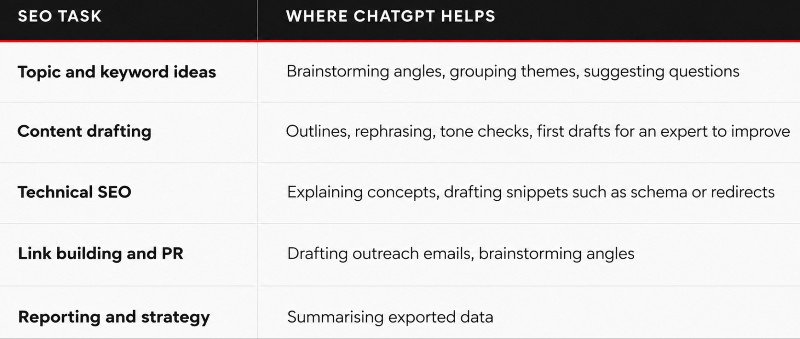
The bigger risk is a hidden one. Content produced by AI without real expertise tends to be exactly the commodity content that Google’s guidance says performs worse in generative AI search, and it gives ChatGPT no reason to cite you. Google doesn’t penalise AI-assisted content as such, but its guidance on AI-generated content and its people-first content guidance put the emphasis on originality, accuracy, and value to the reader.
That’s why cutting corners is usually a false economy. A cheap process that produces pages which don’t rank, don’t get cited, and don’t convert still costs you: the time spent producing them, the time spent fixing them, and the months of visibility you didn’t earn in the meantime. An expert service adds what a chatbot can’t: access your data, be accountable for the results, technical execution, organic relationships with publishers, and a strategy that connects all of it to enquiries and revenue.
The best approach is usually a blend. Let tools like ChatGPT speed up the parts of the process that benefit from speed, and keep specialists in charge of the decisions that benefit from human judgement.
How to Measure Your ChatGPT Visibility
Measurement is the part of ChatGPT SEO that frustrates marketing teams most, because a standard SEO report doesn’t capture it. There’s no ‘position’ to track, and a recommendation that never produces a click is invisible to traditional analytics. In practice, you need a blend of methods:
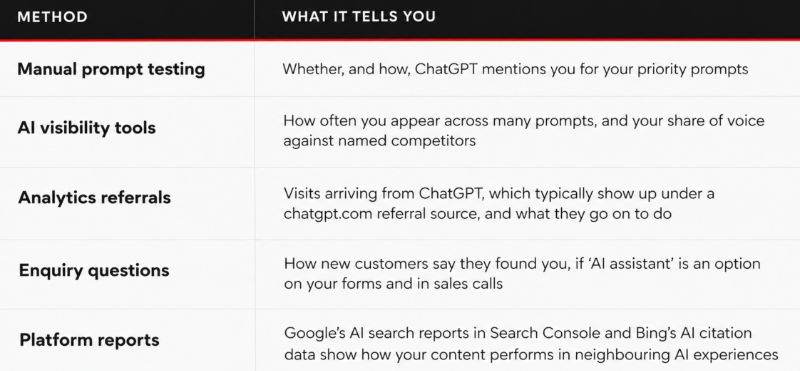
For reporting, we’d recommend tracking a small set of metrics consistently:
- Mention rate: the share of your priority prompts where your business is named.
- Citation rate: how often your own pages are cited as a source.
- Share of voice: your mentions compared with named competitors.
- Accuracy and sentiment: whether what ChatGPT says about you is correct and favourable. Errors should be addressed on your end.
- Referral sessions and conversions: traffic and enquiries from ChatGPT, and where they can be measured, such as the AI search reports in Search Console and Bing’s AI citation data
Not sure where your business currently stands? If you need a clear view of how visible you are across ChatGPT and other AI platforms, get in touch with us and we’ll talk you through what an AI visibility review can look like for your brand.
Should You Do ChatGPT Optimisation In-House or Hire an Agency?
Some of this work is well within reach of an in-house team: tightening page structure, writing clearer and more specific content, updating key pages, and testing prompts. The elements that tend to benefit from specialist support are schema markup at scale, technical crawl and indexation issues, structured digital PR, and cross-platform visibility tracking that connects to commercial results.
If you’re at the stage of choosing an AI SEO agency, these are the questions you should ask:
- How will you benchmark where we are today? A credible answer involves a baseline across prompts and competitors.
- Do you guarantee ChatGPT rankings? If the answer is yes, walk away.
- How does this build on our existing SEO? Strong agencies treat AI visibility as an extension of SEO, not a replacement.
- How will you measure success, and what are the limits of that measurement? You want the truth about the gaps, and a plan to bridge them with analytics and enquiry data.
- Who does the technical, content, and PR work? Check whether the expertise is in the team or outsourced.
- What should we expect in the first three months? Realistic answers focus on technical improvements and clearer citation focus first, with gains building over time.
For context, boxChilli has been helping businesses adapt to changes in search since 2006, and our in-house team of more than 30 specialists covers technical SEO, AI SEO, content, digital PR, analytics, and website design and development under one roof.
Frequently Asked Questions
What is ChatGPT SEO?
ChatGPT SEO is the practice of improving how often and how accurately ChatGPT finds, mentions, cites, and recommends your business. It builds on traditional SEO and adds machine-readable structure, citation-ready content, off-site trust signals, and AI visibility tracking.
How do I get my business to appear in ChatGPT?
Start by making sure OpenAI’s search crawler, OAI-SearchBot, can access your site, including from its published IP ranges. Then build strong SEO foundations, publish specific, expert-led content that answers the questions your customers ask, keep your business information consistent across the web, and earn original reviews and mentions from credible sources. There’s no way to guarantee an appearance, but these steps improve your chances.
Does blocking GPTBot stop me appearing in ChatGPT?
Not necessarily, because OpenAI treats its crawlers separately. GPTBot relates to training, while OAI-SearchBot is what surfaces sites in ChatGPT’s search features. You can block one and allow the other, but check your settings carefully so you don’t accidentally block both. If you allow both, OpenAI says it may use the results of one crawl for both purposes.
Which OpenAI crawlers should I allow?
OpenAI lists four user agents. Allow OAI-SearchBot if you want to appear in ChatGPT’s search answers. GPTBot is a training decision, so that one is your call. ChatGPT-User acts on a person’s request and isn’t used to decide search inclusion, so robots.txt rules may not apply to it. OAI-AdsBot only visits pages submitted as ChatGPT ads, so it’s irrelevant to organic visibility.
Is ChatGPT SEO different from Google SEO?
They overlap heavily. Both reward crawlable, helpful, trustworthy content. The differences are in the interface, because ChatGPT returns a synthesised answer rather than a list of links; in measurement, because mentions and citations replace rankings; and in the emphasis on off-site corroboration and prompt-based research.
How long does ChatGPT optimisation take to work?
Like SEO, it’s a longer-term investment. Technical fixes and clearer content structure can show early progress within the first few months, while more meaningful gains in visibility and enquiries build as your authority grows. Be wary of anyone promising overnight results.
Can I just use ChatGPT to do my SEO instead of paying an agency?
You can use it to support parts of the process, such as brainstorming, outlining, and summarising data. The thing is, it can’t access your analytics, crawl your site, earn links, or take accountability for results, and unedited AI content is typically the generic, commodity material that struggles to rank or be cited. For most businesses, the value is in pairing the tool with real expertise.
How do I know if ChatGPT is mentioning my business?
Start by asking it the questions your customers would ask, and note which businesses it names, which sources it cites, and whether the details about you are accurate. Because answers vary, repeat the test over time, and consider a visibility tool for a more systematic view.
Key Takeaways
- ChatGPT SEO can mean two things: Getting your business found in ChatGPT, and using ChatGPT to do SEO. The first needs proper optimisation work, and the second needs expert oversight.
- There are no fixed rankings: You’re improving the probability of being retrieved, cited, and recommended, so be sceptical of guarantees if a prospective agency offers them.
- Foundations come first: Crawlable, well-structured, authoritative sites are the base on which everything else relies.
- Let the right crawler in: OAI-SearchBot is what helps your pages appear in ChatGPT search, and it’s separate from GPTBot.
- Create content worth citing: Specific, expert-led, and original beats generic every time.
- Build trust beyond your site: Genuine reviews, coverage, and consistent information help ChatGPT feel confident recommending you.
- Measure with several methods: Combine prompt testing, visibility tools, and analytics, and be transparent about the gaps.
- Shortcuts cost more than they save: ChatGPT is a useful assistant, but it’s no replacement for strategy, data, and accountability.
Ready to Get Found in ChatGPT?
Search is broadening rather than being replaced, and the businesses that adapt steadily, by reinforcing strong SEO foundations and adding the AI-specific layer on top, tend to hold their visibility far better than those reacting to every headline and shallow Search shortcut.
If you’d like to know where your business currently stands across ChatGPT, Gemini, AI Overviews, and the other platforms your customers are using, get in touch with the boxChilli team or find out more about our AI SEO and GEO service.