
.
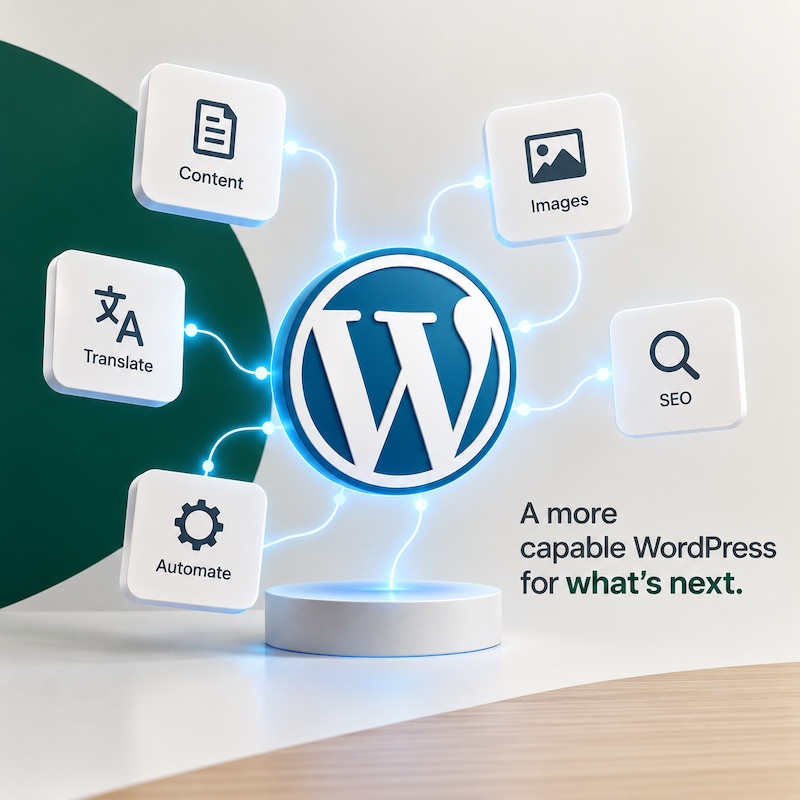
WordPress is taking a significant step towards making AI a more integrated part of how websites are built, managed and updated. With WordPress 7.0, the platform has introduced new AI infrastructure that gives plugins a standard way to work with external AI providers such as OpenAI, Anthropic and Google, while the new AI plugin for WordPress is showing what that could look like in practice through features for content generation, image creation, editing, translation, summaries, SEO tasks and editorial support.
At first glance, some of those features may sound familiar because there are already plenty of AI tools that can generate copy, create images or suggest metadata. The more interesting development is what sits underneath them, because WordPress is beginning to create a common AI framework within the platform rather than relying entirely on separate, provider-specific integrations.
How the New WordPress AI Setup Works
The key pieces introduced in WordPress 7.0 are the AI Client and Connectors API. The AI Client allows a plugin or feature to request a capability, such as text generation, image generation or image analysis, without needing to be built around one specific AI provider, while the Connectors API handles the connection to external services and the credentials required to use them.
In practical terms, a feature does not necessarily need to be designed specifically for ChatGPT, Claude or Gemini. Instead, it can ask WordPress for the capability it needs and use a compatible connected provider that supports that type of request, which creates a much more flexible foundation for AI functionality than building every feature around its own separate API integration.
The AI plugin for WordPress sits on top of that infrastructure and acts as a feature plugin, giving users and developers an early look at the kinds of tools that can be built with it. To use the plugin, WordPress 7.0 or later is required along with at least one compatible AI provider configured through the new Settings → Connectors area.
What Can the AI Plugin Actually Do?
The current plugin includes a mix of practical features and experiments focused mainly on content and publishing workflows. Users can generate and edit images directly within WordPress, while content tools can shorten, expand, rephrase, summarise or translate existing copy and even provide type-ahead suggestions while someone is writing in the block editor.
There are also several features aimed at the smaller publishing tasks that can take up a surprising amount of time across content and SEO teams, including title generation, excerpt generation, SEO-friendly slug suggestions, meta descriptions, category and tag recommendations and AI-generated alt text for images. The plugin also includes editorial tools that can review content for accessibility, readability, grammar and SEO, then provide recommendations or, in some cases, apply suggested changes.
None of those individual capabilities is especially new, but bringing them directly into WordPress makes them more useful from a workflow perspective. Instead of creating content in one platform, editing images in another and then transferring everything into the CMS, more of that process can potentially happen in the same place where the website is already being managed.
Why This Is Particularly Relevant for boxChilli
At boxChilli, we build primarily on WordPress and use dedicated WordPress hosting, so changes to the platform itself are naturally something we pay close attention to. We are also deliberately selective about the plugins we introduce into client websites because unnecessary plugins can create bloat, add maintenance overhead, cause compatibility issues and affect performance, which is why we generally favour lean builds with functionality that has a clear purpose.
That is what makes this development more interesting than simply seeing another third-party AI plugin arrive in the WordPress ecosystem. The AI plugin is being developed through the WordPress Core AI team and is designed to demonstrate the capabilities made possible by WordPress 7.0’s new AI Client and Connectors infrastructure, so it feels much closer to the direction WordPress itself is moving in rather than another unrelated tool being bolted onto the backend.
Our WordPress development and support team is already setting the functionality up on a staging environment so we can test it properly across different use cases. If it proves useful, there is clear potential for it to support future website deployments and for us to explore where it could also help existing SEO, content and website support clients, particularly where it can remove repetitive tasks without compromising the quality or maintainability of the websites we build.
What Could This Mean for Website Workflows?
For us, the most immediate opportunity is around making everyday workflows more efficient. If content can be refined directly within WordPress, images can be generated or edited without leaving the CMS and smaller publishing tasks can be handled more quickly, there is potential to reduce a lot of unnecessary back and forth between platforms across development, SEO, content and support.
That does not mean handing content production over to AI or using every available feature simply because it exists. The value will come from using AI where it removes repetitive work and supports existing expertise, allowing teams to spend more time on strategy, creative thinking, technical decisions and the areas where human judgement still matters most.
There is also a longer-term point here, because the architecture WordPress is building goes beyond AI writing tools. WordPress is also developing technologies such as the Abilities API and MCP Adapter, which are intended to help external AI systems interact with WordPress functionality more effectively as the wider web moves towards more agentic experiences.
It is still early, and much of that remains experimental, so there is no reason to rebuild websites around speculative AI requirements. The fundamentals that already support good websites remain just as important, including stable URLs, semantic HTML, structured data, accessible markup and well-organised content that can be understood easily by users, search engines and AI systems alike.
Final Thoughts
There are already countless AI tools available for WordPress, so the ability to generate a title or rewrite a paragraph is not really the main story here. What is more significant is that WordPress is creating a standardised foundation for connecting AI providers and building features that can use those capabilities without every developer having to create a completely separate integration.
For an agency like ours, which builds primarily on WordPress and takes a deliberately lean approach to development, that direction is much more interesting than simply adding another AI plugin to the stack. We are still at the testing stage, but if the technology proves useful in real-world workflows, it could become a practical part of how WordPress websites are built, updated and managed without adding unnecessary complexity.