.
AI-powered search is the phrase we’re hearing in the industry most at the moment, from Google’s AI Overviews to tools like ChatGPT and Copilot shaping how people research, compare and sense-check decisions before they ever speak to a supplier. It’s no surprise that many business owners and marketing leads are questioning whether the rules around being found online have changed overnight.
That uncertainty is understandable, particularly as click behaviour looks different, visibility doesn’t always translate into traffic in the way it once did, and new terms like AEO, GEO and AI SEO are being added to an already crowded digital marketing conversation. In that environment, it can start to feel as though SEO has been replaced rather than simply evolving.
In reality, the shift is far less dramatic. Search and SEO haven’t died (despite how often that claim has surfaced over the last 20 years), and no, they haven’t been taken over by AI either. What has changed is the breadth of the landscape, with more touchpoints now influencing decisions long before a website visit takes place. AI-powered tools are very much part of that journey, but they don’t sit in isolation, and they certainly don’t make the fundamentals of visibility, trust and conversion redundant.
This article looks at how people actually search and choose suppliers today, where AI-powered search fits into that process, and what businesses should focus on if they want to stay visible, credible and competitive heading into 2026.
Search Hasn’t Been Replaced, It’s Just Broader Than It Used to Be
There’s a growing narrative that AI has replaced search, that Google no longer matters, and that SEO is something businesses should be moving away from. It’s an understandable conclusion when new tools appear quickly and behaviour starts to look different on the surface, but it doesn’t reflect how people actually search or make decisions in practice.
Simply put, search hasn’t disappeared and it hasn’t been taken over by AI-powered search, ChatGPT or any other system like these. What has changed is the breadth of the search landscape and the number of places people now turn to as part of the same decision-making journey.
For example, people commonly use:
- Google to find services, products and local businesses
- YouTube to understand how something works
- Amazon or other marketplaces to compare products
- Google Maps when location and proximity matter
AI-powered tools like ChatGPT, Copilot and Google’s AI Overviews have added another layer to this behaviour rather than replacing it. They’re often used to explore a topic, sense-check options or narrow down choices, especially at the research and comparison stage – 75% of all conversations on ChatGPT cover looking for practical guidance, seeking information and content writing.
This is why the idea that AI has taken over search is misleading… People still rely heavily on traditional search engines like Google when they are ready to compare providers, check credibility or make a purchase, particularly for services, local searches and higher-value decisions. In the UK, Google still accounts for around 92% of search engine usage, and in our own data at boxChilli, traffic attributed directly to ChatGPT across 2025 represented under 1% of total website visits).
The real adjustment for businesses is the understanding of how choices are now made. Customers are researching, comparing and forming preferences across a wider set of places, with the website often coming later in the process rather than at the start.
When you look at it through that lens, SEO hasn’t disappeared or been replaced. It has simply had to stretch and evolve to support a broader journey, one where visibility, trust and consistency need to show up across multiple touchpoints rather than relying on a single moment in Google’s 10 blue links. Businesses that take the time to understand that behaviour, and adjust steadily rather than react emotionally to headlines, tend to hold their ground far better as the landscape continues to shift.
Intent Matters More Than Ever
As search continues to evolve and spread across more platforms, search intent has become the most reliable way to stay grounded and easiest way to refer back to how customer journeys happen. Channels will come and go, interfaces will change and new tools will influence behaviour, but the underlying reason someone is searching remains the strongest signal a business can work from.
Where we see things start to unravel is when that intent gets blurred. Everything becomes “content” or “SEO” or “visibility”, without enough thought given to what the person on the other side is actually trying to achieve at that moment. When that happens, businesses often end up publishing in more places than ever, yet feeling less certain about what’s actually contributing to enquiries or revenue.
When you strip it back, most searches still fall into a small number of familiar patterns, and while the platforms involved have expanded, the intent behind them hasn’t fundamentally changed.
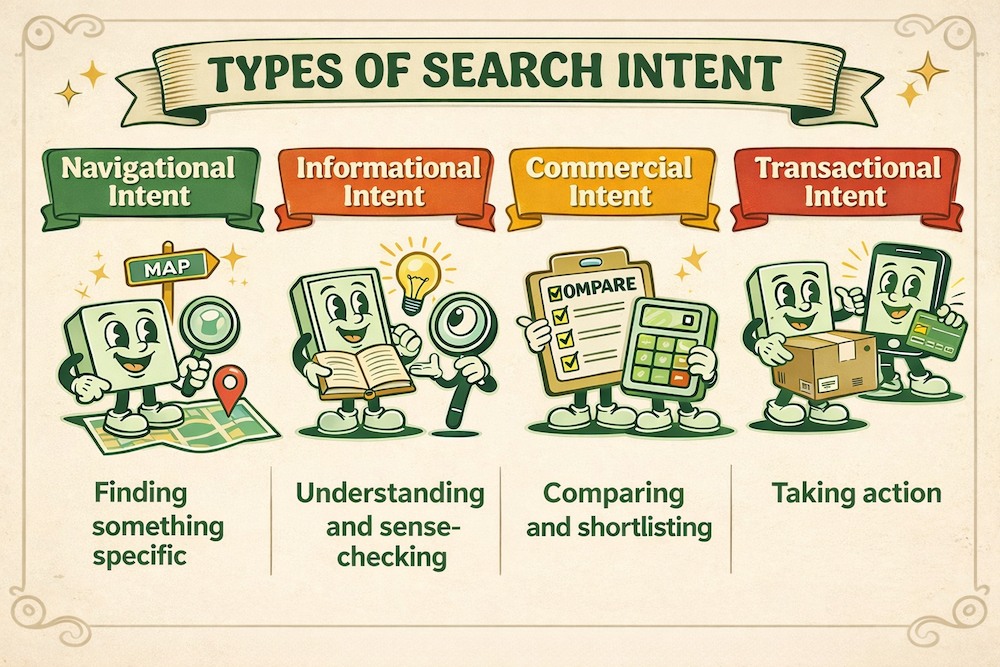
Below are the 4 core intent types in SEO described by our SEO Manager, Owen.
Navigational intent: finding something specific
Awareness already exists
↓
‘Traditional’ search used to confirm legitimacy
↓
User checks brand, location, credibility
↓
Decision to engage or move on
Navigational searches tend to happen once awareness already exists, whether that’s through a recommendation, a social post, an AI summary or previous experience, and the role of search at this point is usually confirmation rather than discovery. In practice, this still sits very comfortably with Google, particularly for service businesses and local searches, because it remains the fastest way to validate that a company exists, looks legitimate and can be trusted.
Where this stage often breaks down isn’t through lack of demand, but through overlooked fundamentals. Inconsistent business information, neglected Google Business Profiles, weak branded search results or a website that doesn’t reflect expectations set elsewhere can quietly introduce doubt at exactly the point where confidence should be increasing. I’ve seen businesses lose enquiries here despite strong visibility simply because the basics weren’t being maintained consistently enough to support that moment of validation.
From an experience and trust perspective, this stage is less about persuasion and far more about reliability, because if a user or an AI system can’t easily verify who you are, where you operate and what you offer, trust erodes quickly regardless of how visible you might appear elsewhere.
Informational intent: understanding and sense-checking
Problem or curiosity identified
↓
User seeks explanation or guidance
↓
AI tools, search and video used together
↓
Understanding shapes future searches
Informational searches sit much earlier in the journey and are driven by curiosity, uncertainty or the need to make sense of something before any decisions are made. This is where AI-powered tools have naturally found a role (like those bits at the top of Google – called AI Overviews), because they’re well suited to summarising, explaining and helping people orient themselves around a topic, particularly when someone doesn’t yet know what questions to ask next.
This has also accelerated the rise of zero-click behaviour, where someone gets enough of an answer directly from the results page or an AI summary without needing to visit a website at all. While that can feel uncomfortable for businesses looking at declining click-through rates, it’s really just another evolution of how search has been working for years, rather than a sudden break from it.
That said, this behaviour hasn’t replaced traditional search so much as layered on top of it. In reality, I see people moving between AI tools, search engines and video platforms quite fluidly, using each to build understanding in different ways, before eventually narrowing their focus. The intent remains consistent even when the platforms involved change.
The challenge for businesses at this stage is that surface-level content rarely holds up for long. Generic explanations, recycled phrasing and content written purely to satisfy an algorithm tend to struggle, because both users and AI systems are looking for clarity, depth and signals of real experience. In my experience, content that reflects practical insight and genuine understanding tends to perform more consistently over time, because it builds trust rather than simply answering a question in isolation.
Commercial intent: comparing and shortlisting
Shortlist begins to form
↓
User compares approaches and providers
↓
AI summaries, reviews and service pages used
↓
Trust and fit determine who progresses
Commercial intent sits between understanding and action, and it’s where people begin narrowing their choices and forming preferences. At this point, behaviour often spans multiple platforms, with AI tools used to summarise or compare approaches, search engines used to explore specific providers and review platforms used to validate claims.
This is where credibility start to matter more than visibility alone. Businesses often assume competitors are outperforming them because they’re better marketers, when in reality it’s usually because they’re easier to understand and easier to trust. Clear service explanations, relevant examples, visible reviews and consistent messaging reduce uncertainty far more effectively than confident language, because they help someone decide whether a business feels like the right fit rather than simply the loudest option.
From an authority perspective, this is where experience needs to be demonstrated rather than stated, because as AI systems increasingly surface content that appears consistent and well-supported, vague positioning tends to fall away in favour of businesses that make their expertise easier to verify.
Transactional intent: taking action
Decision largely made
↓
User looks for fastest, safest route
↓
Search used to confirm and act
↓
Conversion depends on confidence and ease
Transactional searches happen when someone is ready to enquire, book or buy, which is why traditional search engines still dominate this stage, particularly for services, local searches and higher-value decisions. At this point, people aren’t exploring or comparing broadly, they’re confirming that they’ve chosen correctly and that the next step feels safe and straightforward.
What tends to get in the way here isn’t traffic, but friction. Slow pages, unclear calls to action or buried trust signals can quietly derail high-intent users, which is why improving conversion rates at this stage often delivers a better return than chasing more visibility without fixing the journey.
It’s also worth noting that AI platforms are beginning to test ways into this intent, with paid placements and ads being trialled in tools like ChatGPT in the US. That signals where things may head over time, but for now, when people are ready to act, they still rely on environments like Google and Bing. This is also why conversion remains a core part of search strategy, because even as platforms evolve, confidence at the point of action is what ultimately turns intent into results.
Where AI-Powered Search Fits (And Where It Doesn’t)
As search behaviour spreads across more platforms, AI-powered tools are best understood as shaping decisions upstream rather than replacing the moments where decisions are confirmed. They influence how people think, what they compare and which questions they ask next, but they rarely remove the need for traditional search, especially once intent sharpens.
Where AI-Powered Search Fits
AI-powered search aligns most strongly with informational and early commercial intent, where uncertainty is still high and users are trying to orient themselves before committing to a direction.
Common examples include:
- When someone wants a quick explanation of an unfamiliar topic, AI tools such as ChatGPT are often used instead of opening multiple articles and piecing together an answer manually.
- When a decision is being considered but not yet committed to, such as whether leasing equipment makes sense, whether switching utilities is worthwhile, or what happens during a professional assessment, AI is a low-friction way to build initial understanding.
- When people are comparing ideas rather than specific businesses, AI-powered search works well. Questions around trade-offs, expectations or general costs are easier to explore conversationally before formal research begins.
- For inspiration or simple demonstrations, short-form video platforms like YouTube or Instagram are often preferred over long written guides, particularly when speed and clarity matter more than depth.
In these cases, AI and alternative platforms are replacing the early exploration phase that blogs and guides traditionally served, rather than replacing the decision itself.
Where AI-Powered Search Doesn’t Fit (Yet)
As intent sharpens and decisions move closer to action, AI-powered search starts to lose effectiveness, largely because the needs at this stage shift from understanding to certainty, reassurance and execution.
Common examples include:
- AI tools are not used for navigational searches. When someone wants to reach a specific website or service, they still rely on Google or another search engine to get there quickly and reliably, not AI.
- When a purchase is imminent, such as buying household goods, booking travel or ordering food, people look for prices, availability, delivery details and reviews, not summarised advice.
- Urgent or time-sensitive needs, including repairs, medical appointments or breakdown services, are handled through local search and maps, where proximity and immediacy matter.
- When booking services or appointments, users prefer platforms that show real availability and allow immediate action rather than conversational exploration.
- In situations involving financial commitment, responsibility or risk, people look for verifiable businesses, clear processes and accountability. Generated summaries alone do not provide that reassurance.
What Actually Improves Visibility in an AI-Powered Search World
As AI-powered search becomes part of everyday behaviour, it’s tempting to think that visibility and good SEO now depends on learning a new set of rules. In reality, what’s changing is how information is surfaced, not what makes a business credible or worth showing in the first place.
Whether it’s a search engine, an AI summary or a person scanning a page, the same questions are being asked in the background. What does this business actually do? Does it feel legitimate? And does it look like a sensible option compared to the rest? The businesses that continue to perform well are the ones that make those answers easy to understand and easy to verify, regardless of how or where someone first encounters them.
The visibility signals that matter most remain familiar:
- Clear service explanations that remove ambiguity and make it obvious what a business does and who it serves. Vagueness undermines both human and machine understanding.
- Consistent messaging across all touchpoints, including website content, local profiles and third-party platforms, so that no contradictory signals confuse users, search engines or AI systems.
- Visible proof of credibility, such as genuine reviews, case studies, recognisable experience and brand mentions. Today, AI systems look for completeness and context in data, not just keywords.
- Technical reliability and structure, which ensure information can actually be crawled, interpreted and used. Things like schema markup act as translators that help AI assistants and bots understand what content means rather than just hope they infer it.
- Depth and usefulness of content, where pages go beyond surface explanations and actually help someone understand, compare or decide. Content that reflects real experience, nuance and practical insight tends to hold up far better than thin pages written to tick a keyword box.
- Clear ownership and accountability, showing who is behind the content and the business itself. Signals such as named authors, visible teams, company information and consistent branding help both users and AI systems assess legitimacy and trustworthiness.
- Topical authority built over time, where related content supports a clear area of expertise rather than isolated pages chasing individual terms. Consistency across themes makes it easier for search engines and AI models to understand what a business is genuinely knowledgeable about.
- Engagement and behaviour signals, including how users interact with content once they arrive. Pages that encourage reading, scrolling, interaction and onward journeys tend to reinforce relevance and quality far more effectively than pages people abandon quickly.
- Clean internal structure and linking, so important pages are easy to discover and logically connected. This helps crawlers, AI systems and users understand what matters most, rather than leaving everything to chance or external links alone.
- Alignment between intent and content, ensuring pages actually match what someone is trying to achieve at that stage of their journey. When intent is satisfied cleanly, visibility becomes more stable and less dependent on constant tactical adjustment.
Staying Visible Online as Search Broadens Beyond Google
Looking ahead to 2026, adapting to AI-powered search is less about adopting a brand new discipline and is actually more about reinforcing what already works. Search has broadened, intent is shaped earlier and across more platforms, and AI tools increasingly influence how people research and compare, yet the fundamentals of good SEO remain unchanged. Clear service explanations, consistent messaging, visible proof of experience and technically reliable websites are still the signals that search engines, AI systems and users rely on when deciding what deserves attention and trust.
What has changed is where and when those signals are interpreted. Structure, consistency and depth now matter earlier in the journey, because AI systems summarise and filter information before a website visit takes place, while websites themselves increasingly act as decision checkpoints rather than points of discovery.
Businesses that adapt steadily by tightening their fundamentals, demonstrating real expertise and reducing friction at the point of action tend to perform more consistently than those reacting to new labels or chasing surface-level visibility. In that sense, AI-powered search does not replace SEO, it simply reinforces the value of doing it properly.