
.
On Tuesday 10th February 2026, Microsoft announced a major update to Bing Webmaster Tools that could change how SEOs approach AI-driven search.
Bing has launched a new AI Performance report in public preview, giving site owners visibility into how their content appears in AI-generated answers and summaries. For the first time, we are getting real first-party data on AI citations, grounding queries and visibility trends, albeit, on Bing…
What Is the New AI Performance Report?
The new AI Performance tab sits within Bing Webmaster Tools and focuses specifically on how your website performs in Microsoft’s AI-powered search features such as Bing AI summaries, Copilot and its partners.
Instead of relying on assumptions, you can now see:
- When your content is cited by AI
- Which pages are being used
- What types of queries trigger AI answers
- How visibility changes over time
It connects traditional search performance with generative AI results in a way we have not seen before, which is huge news in the world of AI SEO, GEO or whatever you want to call it!
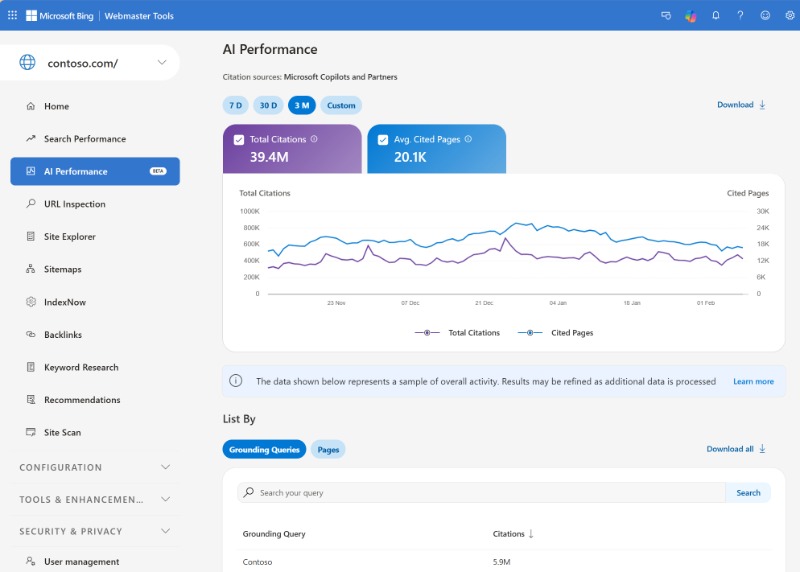
What Data Does Bing Now Provide?
1. Average Cited Pages
This shows how many of your website’s pages appear in Bing’s AI-generated summaries. It gives you a clear sense of:
- How much of your content is being trusted
- Whether your site is becoming a regular source
- How widely your content is being referenced
For content-led brands and publishers, this is especially valuable.
2. Grounding Queries (Fan-Out Queries)
One of the most powerful features is Grounding Queries. These reveal the key phrases and sub-queries Bing’s AI uses when building an answer.
- In practical terms, this means you can now see:
- What questions users are really asking
- How Bing expands and interprets queries
- Which topics your site supports in AI results
This is similar to “fan-out queries” and gives unprecedented insight into AI search intent.
3. Visibility Trends
The Visibility Trends report shows how your AI citations change over time. You can track:
- Growth or decline in AI exposure
- The impact of content updates
- The effect of algorithm changes
- Seasonal patterns
This turns AI visibility into something you can actively monitor, rather than guess.
4. Page-Level Citations
Finally, Bing now shows citation counts at page level. You can see exactly:
- Which URLs are being referenced
- How often they appear
- Which content performs best in AI summaries
This makes it much easier to optimise high-performing pages and replicate success.
Why This Is Enormous for AI SEO
Until now, AI search visibility has been largely opaque. We knew AI systems were using web content, but there was no reliable way to measure it inside the platforms themselves.
Over the past year, a number of third-party AI and LLM tracking tools have emerged, aiming to monitor brand mentions, citations and visibility across generative search experiences. While useful for spotting trends, most rely on scraped data, sampled prompts, and simulated environments, as a result, they are directional rather than definitive, and rarely 100% accurate.
This is what makes this update from Microsoft so significant.
Yes, it is Microsoft Copilot and Bing AI summaries, and it represents a smaller pool of data when compared to Google (which still dominates search engine usage), but it is also the first time we are getting meaningful first-party insight into how content performs inside an AI-powered search environment. For the first time, SEOs can see AI citation data directly from the source, inside Bing Webmaster Tools, rather than relying on estimates and external tools.
With this update, teams can properly track how content influences AI responses, identify which pages perform best, refine topic coverage, build authority more strategically and align their SEO efforts with real AI search behaviour. This moves AI optimisation from theory into something practical and measurable, so for anyone thinking seriously about AI SEO and GEO, it represents a major step forward.
How This Compares to Google
At the moment, Google does not offer anything similar in Search Console.
Despite rolling out AI-powered features such as AI Overviews, there is currently no reporting on:
- AI citations
- Grounding queries
- AI visibility trends
- Page-level usage
That is what makes Bing’s move stand out even more, because it represents a level of transparency that has so far been missing from AI-powered search. By opening up access to citation and visibility data, Bing is setting clearer expectations around how generative results should be measured and understood. In doing so, it also puts pressure on Google to respond with similar reporting in Search Console.
Final Thoughts
From my perspective, this is one of the most important developments I have seen in AI search data yet. For a long time, understanding how content performs in generative search has relied on testing, assumptions and third-party tools that can only ever provide partial insight, which has made it difficult for marketing teams to confidently report on AI visibility or justify investment in AI-focused optimisation.
That is why this update from Microsoft matters. Yes, it is Bing and represents a smaller share of search compared to Google, but it is still meaningful first-party data from a major platform. It gives marketing teams at least something tangible to measure, analyse and build strategy around, rather than relying purely on estimates.
If Google does a similar thing with its reporting, AI performance will quickly become a measurable part of everyday SEO and content strategy rather than a developing theory. Until then, Bing has taken the lead, and this update sets a clear benchmark for what transparency in AI search should look like.