.
Why choosing a digital agency feels harder than it should
If you’re a business owner or a marketing leader looking for digital support, the issue is rarely that you cannot find a service provider who says they can help. If anything, the opposite is true, because the market is currently full of agencies, freelancers and specialists who all appear confident, all seem capable and all sound as though they have the golden process that will deliver results.
The difficulty is when it comes to choosing the right one with genuine confidence, especially when digital marketing now sits much closer to the commercial engine of a business than it used to. It influences lead flow, sales conversations, recruitment, reputation and long-term growth, and when things go well, it makes planning easier and performance more predictable. However, when it goes wrong, the impact is not always immediate, but it often shows up later as volatility, slower pipeline and a creeping sense that you’re doing more while gaining less certainty.
That’s also why this decision carries more weight than people like to admit. The allocated budget is hard-earned, the stakes are real and the consequences are rarely confined to a marketing report, because marketing performance has a habit of becoming business performance over time, particularly for SMEs where every lead and sale matters.
So if choosing a digital agency feels unusually difficult right now, it’s not because you’re behind or missing something obvious. It’s because the market has become noisier, more uneven and harder to read from the outside, even when you’re doing everything you can to make a sensible decision.
Which leads to the question many quietly ask themselves. Why does this feel so difficult when it should be straightforward?
The illusion of choice in modern digital marketing
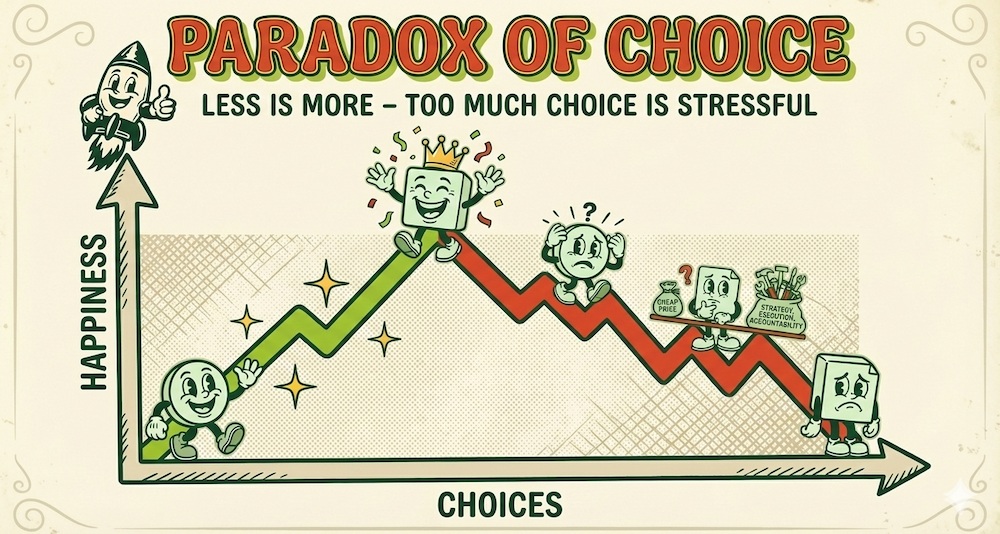
In an ideal world, it would be nice if more choice made the decision easier, but in digital marketing it often does the opposite, because the barrier to entry has dropped sharply and the market has expanded faster than the ability to judge quality from the outside. This is called the Paradox of Choice, a concept introduced by psychologist and funnily enough SEO guru, Barry Schwartz.
Tools are more accessible, platforms are easier to use and AI has made many forms of execution faster, which means that producing activity now looks deceptively simple, even though the thinking that makes that activity effective remains as complex as it has ever been.
This is where the illusion of choice really kicks in, because surface-level credibility is easier to manufacture than it used to be.
Why so many agencies look the same on the surface
- Polished websites and confident messaging
- Well-designed reports and dashboards
- Familiar service lists and frameworks
- Fast turnaround on visible outputs
- Confident use of industry buzzwords
- Clean process diagrams and roadmaps
- Platform badges and partner logos
Now, none of these things are inherently bad because some agencies are genuinely great at what they do, but they make it far harder to distinguish between providers who are delivering activity and those who are guiding decisions. From the outside, many agencies appear established and capable, even when the work behind the scenes is fragmented, lightly resourced or driven by tactics rather than judgement.
At the same time, business owners and marketing leaders are being asked to judge capability across disciplines they don’t live inside every day. SEO, paid media advertising, social media, website performance, tracking and reporting all sit under the same “digital marketing” umbrella, and while that’s manageable when you have a trusted partner, it becomes exhausting when you’re expected to assess expertise while also running a business, leading a team or trying to protect growth through uncertain conditions.
The irony is that as the tools get easier and execution becomes quicker, strategy becomes more valuable rather than less. In a digital era that keeps shifting, the businesses that perform consistently tend to be guided by perspective, prioritisation and the ability to connect decisions back to commercial outcomes, rather than by whoever can produce the most activity for the lowest price.
Which is why the real risk in this market is rarely choosing the wrong agency in the first place. The real risk is not realising it early enough.
The real cost isn’t the retainer, it’s what happens around it
When businesses talk about the cost of an agency relationship, it’s natural to focus on the retainer price because it’s the most visible part of the decision, yet in reality, it’s rarely the most expensive part. The larger cost tends to sit around it, building quietly over time through delayed learning, lost momentum and the gradual disconnect between effort and commercial impact.
Time and momentum loss
One of the most common patterns we see at boxChilli is the slow drift into “let’s give it another quarter,” where work is being delivered and updates are happening, yet clarity never really arrives, so the business stays in waiting mode.
Instead of learning quickly and adjusting decisively, the feedback loop stretches out, the relationship becomes a cycle of delivery and reporting, and marketing starts to feel like something happening alongside the business rather than something actively supporting business growth.
Fragmentation and misalignment
Alongside time loss, there’s often the quieter cost of fragmentation, where SEO sits in one corner, paid media sits in another, social content exists somewhere else and the website is treated as a separate project entirely.
Each channel may look busy on paper, yet because there’s no single strategic narrative tying them together, the work doesn’t compound, messaging drifts, priorities conflict and performance becomes harder to interpret because nothing is working as a cohesive system.
Data without direction
This is usually where frustration becomes real, because reports can still look healthy while confidence declines.
Metrics move, graphs trend in the right direction and activity continues, yet the questions that actually matter remain unanswered, including what is driving leads, why enquiries fluctuate, what is changing in lead quality and where the next decisions should be focused.
When reporting doesn’t connect performance back to commercial-related metrics, it stops being insight and starts becoming noise, which is often when marketing leaders and founders find themselves working harder to justify spend while feeling less certain about what is actually happening.
Opportunity cost
The hardest cost to accurately calculate is opportunity cost, because it doesn’t show up cleanly in analytics, yet it’s usually what hurts the most over time. It shows up as potential customers that were never captured, authority that was never built and visibility that was never strengthened while competitors quietly improved, and it also shows up internally as decision fatigue, because when marketing becomes harder to interpret, planning becomes harder too.
This is why the most expensive part of the wrong agency relationship is often invisible until much later down the road, when the business realises that time has passed, activity has happened yet you don’t know the ROI your hard-earned budget has generated.
The emotional toll owners and marketing leaders rarely say out loud
The commercial impact is one side of the story, but the emotional and personal weight often lingers longer, because when marketing feels uncertain it rarely stays contained within marketing and the four walls of your work life.
For founders and owners, this often shows up as being dragged back into marketing when your headspace should be on delivery, cash flow or the next stage of growth. You feel personally responsible for the outcome, because the business is tied to your name, your reputation and, in many cases, your livelihood. Instead of marketing freeing up time or mental space (80% of small business owners in the UK reported experiencing symptoms of poor mental health), it adds to the load, pulling you into conversations you never wanted to be spending energy on and forcing you to question decisions that were meant to be delegated with confidence.
For marketing leaders, the pressure feels different but no less real. You’re expected to stand behind the spend, explain performance and reassure stakeholders, often while working with information that feels thin or incomplete. When communication fades once campaigns go live, or reporting lacks context, accountability doesn’t disappear, but the insight you need to make clear decisions does, which is usually when confidence starts to erode, not just in the agency, but in the setup as a whole.
5 signals that reduce risk when choosing a digital agency
Choosing a digital agency will never be risk-free (including us), and no list can guarantee a perfect relationship. Digital marketing is complex, conditions change and even strong partnerships require adjustment over time. However, after working alongside businesses since 2006 through multiple shifts in platforms, behaviour and technology, certain patterns do become clear.
The signals below are not about finding certainty or perfection, but about reducing the likelihood of frustration later on. They are drawn from experience of what tends to support better decision-making once the fancy pitch deck is over and the day-to-day work begins, and they are intended as a way to look beyond surface reassurance and focus on what usually matters when the relationship is tested in practice.
- Proven experience over time
- A real team behind the work
- Clear and consistent communication
- Case studies with context and outcomes
- Pricing grounded in reality
1. Proven experience over time
One of the most reliable indicators of quality is whether an agency can demonstrate experience beyond the current trend cycle, because digital marketing rarely fails all at once. It changes gradually, through platform updates, shifts in behaviour and new technologies that affect how visibility, trust and conversion are built. Agencies that have only operated within a narrow window may execute to a high standard, but they haven’t yet been tested by those changes, which is often when judgement matters most.
Experience over time shows up less in bold claims and more in perspective. It’s reflected in an ability to explain not just what is changing, but what still matters underneath it, and how decisions should adapt without abandoning fundamentals. That understanding is hard to shortcut, because it comes from seeing strategies evolve across different conditions, and from building a reputation that has been earned through sustained delivery rather than recent visibility.
This is also why longevity and reputation matter. Agencies that have been established for a longer period tend to carry the scars as well as the successes, and that history often translates into calmer decision-making and more measured guidance when conditions shift again.
That experience tends to show up as:
- Evidence of navigating multiple changes in search, platforms and technology
- Comfort explaining what has changed, what still matters and why
- Less reliance on hype, shortcuts or “new” tactics presented as silver bullets
Agencies that have worked through change are usually better placed to prioritise fundamentals and guide decisions when conditions shift again, because they are not reacting for the first time – take GEO, AI SEO and AEO for example. That context helps steady decision-making and reduces the risk of chasing activity that looks current but lacks commercial grounding.
2. A real team behind the work
Digital marketing has expanded to the point that to cover enough disciplines to a high standard, no single person can reasonably hold depth across all of them, particularly as platforms, tools and expectations continue to evolve. This is why the structure behind an agency matters almost as much as the ideas it presents.
A real team doesn’t imply scale for its own sake, but it does suggest that decisions are shaped by multiple perspectives rather than filtered through one individual viewpoint. When specialists across areas such as SEO, paid media, design and development are involved, judgement tends to be broader and more balanced, especially when trade-offs need to be made.
That setup often shows up as:
- Defined roles with clear areas of responsibility
- Collaboration between disciplines rather than isolated delivery
- Shared context that supports continuity over time
Agencies built this way are generally better placed to maintain consistency and adapt as priorities shift, which helps reduce dependency on any one person and makes the relationship more stable as the business grows.
3. Clear and consistent communication
Marketing performance rarely follows a straight line, which is why understanding matters most when results fluctuate rather than when everything looks positive on paper. In that environment, communication becomes a defining part of the agency relationship, because it shapes how confident a business feels in the decisions being made and how well marketing activity can be interpreted, explained and planned around internally.
One of the most common concerns we hear from businesses is simple: THEY STOP HEARING FROM THEIR AGENCY. Early conversations feel engaged and responsive, yet once campaigns are live, updates become less frequent, context becomes harder to come by and insight is replaced by reports that arrive without much explanation. Activity may still be happening in the background, but without ongoing dialogue, it becomes increasingly difficult to understand what is driving performance or where attention should be focused next.
Good communication is not about constant check-ins or volume of contact, because that could get annoying… Instead, it’s about usefulness. When insight explains what is happening, why it matters and how it connects back to wider business priorities, marketing becomes easier to manage internally and easier to justify, even when performance is uneven or conditions change.
That tends to show up as:
- Consistent points of contact who understand the broader picture
- Reporting that provides explanation and direction, not just data
- Conversations that focus on priorities, trade-offs and next steps
When communication lacks continuity or context, uncertainty tends to linger even when activity continues, and over time that silence creates distance, which is often when confidence begins to fade quietly rather than through any single moment of failure.
4. Case studies with context and outcomes
Case studies and portfolios of work are often presented as proof of capability, but their real value lies in what they reveal about how an agency thinks, not just what it has produced. Without context, results can look impressive while offering very little insight into whether the same decisions would make sense for a different business operating under different conditions.
The most useful case studies take the time to explain where a business started, what challenges were present and why particular choices were made, because those details show how judgement was applied rather than simply what tactics were deployed. That context helps you understand whether outcomes came from repeatable decision-making or from circumstances that may not translate beyond that specific example.
That tends to show up as:
- A clear explanation of the starting position and objectives
- Decisions linked to reasoning and business objectives rather than activity alone
- Outcomes described in commercial terms, not just surface metrics
When case studies focus only on outputs or headline numbers, they can build confidence quickly but leave important questions unanswered, whereas those that show thinking, context and consequence tend to reduce uncertainty and support more informed decisions.
5. Pricing grounded in reality
Price is rarely the deciding factor businesses want it to be, but it often becomes the focal point because it’s the easiest element to compare. In a market where tools are cheaper, automation is widespread and execution appears faster than ever, it’s understandable to question why there can be such a wide gap between providers offering what looks, on the surface, like similar services.
The challenge is that while execution has become more accessible, responsibility has not. Deciding what to prioritise, how to adapt when performance shifts and how to connect activity back to commercial outcomes still requires experience and sustained involvement. When pricing sits well below the wider market, it’snot automatically wrong, but it does raise questions about how that responsibility is being carried over time.
Pricing that feels grounded usually reflects a realistic view of what is involved in guiding decisions as conditions change, rather than simply producing outputs. It tends to support continuity, informed challenge and the ability to adjust direction without repeatedly resetting the relationship.
That often shows up as:
- Fees aligned to accountability, not just delivery
- Transparency around what is included and why
- A structure that supports longer-term decision-making
Pricing alone will never guarantee success, but when it reflects the level of experience and responsibility involved, it reduces the risk of confusing visible activity with genuine progress.
What changes when digital marketing is built around the right partner
When the partnership is right, the shift is often felt before it’s measured, because fewer things feel random and fewer decisions feel reactive.
Priorities become easier to agree, channels start reinforcing one another rather than competing for attention, and the business stops feeling as though it’s paying for disconnected strands of activity and starts to feel like it’s building something coherent that supports growth. That shared understanding creates momentum, not because everything suddenly works perfectly, but because decisions are grounded in context rather than guesswork.
Over time, this tends to show up in more tangible ways.
Reporting becomes genuinely useful rather than performative, conversations stay consistent and results begin to feel more attributable, whether that’s steadier lead flow, improved sales quality or clearer links between effort and outcome.
Founders spend less time being pulled back into the detail, marketing leaders spend less time translating activity into impact, and the relationship itself becomes easier to sustain, which is often why stronger agency partnerships last longer than the industry norm.
Above all, the work becomes more enjoyable, because when uncertainty reduces and trust builds, marketing stops feeling like a source of friction and starts feeling like a constructive, reliable part of the business.
Conclusion
Choosing the wrong digital agency rarely feels like a mistake at the time. It usually feels sensible, well-reasoned and justified, until months pass and the cost shows up indirectly through lost momentum, growing uncertainty and the sense that marketing is busy without being genuinely supportive. By the time that becomes clear, the most valuable thing has already been spent, which is time.
The goal is not to find a perfect agency, but to reduce risk by paying attention to the signals that tend to matter once the work begins rather than during the pitch. Experience, structure, communication, context and realism don’t guarantee success, but they do make it far more likely that marketing becomes easier to manage, easier to explain and more closely tied to outcomes that actually matter to the business.
That’s the approach we have taken at boxChilli since 2006, focusing on building long-term partnerships grounded in experience, open communication and marketing that supports real business growth rather than surface-level activity. So, if you’re ready to stop guessing what works and start making confident, data-backed decisions, our team of over 30 specialists are ready to help you get there.