
.
Struggling to get your business found online, even though you’re doing more than you were a few years ago?
For many SME founders and marketing leaders, that feeling is becoming increasingly familiar. Results feel less predictable, enquiries fluctuate too much and approaches that once worked just 2 years ago, no longer deliver the same confidence. In most cases, this is not because marketing has stopped working or you’re putting in less effort, but because the routes customers take to find, compare and choose suppliers have expanded. Zero-click answers, AI-led research and video content now influence decisions well before a website visit ever happens, and that shift has changed what being “found” online really means.
At boxChilli, this is a conversation we are having more often across SEO, paid media and website projects. Businesses are active and investing their hard-earned marketing budget, often working with external agencies, but visibility no longer adds up as neatly as it once did and the connection between effort and outcome can feel harder to pin down. In this environment, the difference between an agency that simply delivers activity and one that understands how all of these moving parts work together has become far more important, especially as the service provider industry itself has become far more crowded and uneven.
This article sets out how discoverability actually works now, what still matters beneath the surface, and where SMEs should focus if they want to protect and grow online visibility through 2026.
I’ll also be covering this in more depth during my session at the Portsmouth Business Expo on 6 February 2026, sharing practical examples of how businesses are adapting as search and user behaviour continue to evolve.
Getting Found Is No Longer a Single Moment
For a long time, digital visibility could be viewed through a relatively straightforward lens, largely because the customer journey was more concentrated around search results and website clicks. A business would appear in Google’s organic 10 blue links, a customer would click through to the website and that visit would either convert or not. Most reporting, decision-making and investment was built around that single interaction.
That is no longer how online discovery works.
Today, search results often answer the question themselves, AI features summarise options before a choice is made and many buyers will watch, read, compare and validate across several places before they ever submit an enquiry. In many cases, the first meaningful interaction with a brand is no longer a service page, but an AI-generated summary (looking at you Google AI Overviews 👀), a short video, a local listing or even a third-party recommendation.
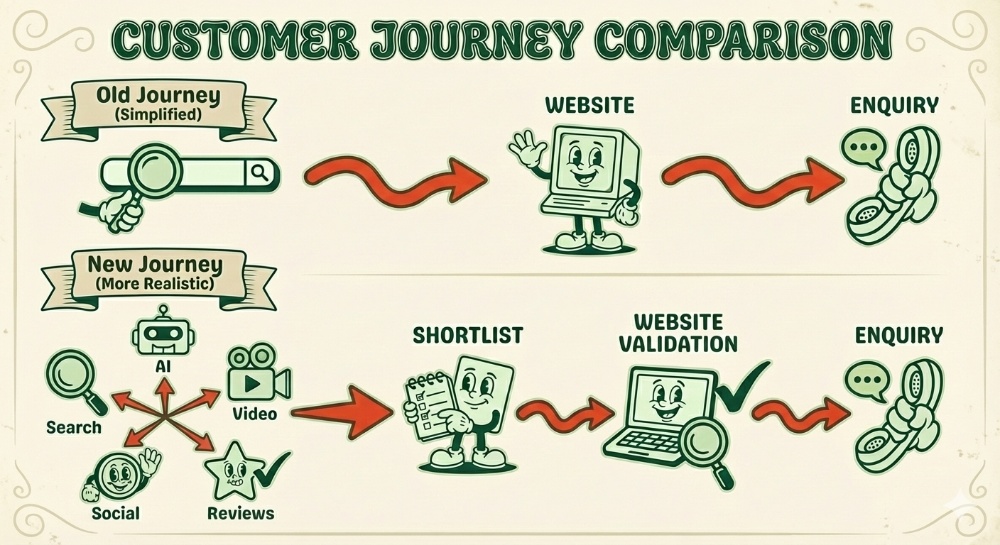
This shift is easy to underestimate because it does not usually show up as a dramatic drop in keyword rankings or website traffic. Reports can still look healthy on the surface, and in a crowded agency market it has become increasingly easy for that data to be used as proof that “things are working”. The problem is that rankings and traffic alone do not pay wages or actually grow a business. When enquiries slow, lead quality drops or revenue stalls, those surface metrics stop being reassuring and start masking a deeper issue. It is entirely possible to appear stable on paper while quietly losing the kind of visibility that actually generates demand and drives sales over time.
That is because getting found online is no longer a single event you win once. It now happens across a series of touchpoints that build familiarity, confidence and preference gradually. Businesses that are consistently present across those touchpoints tend to remain in consideration, while those that rely on one moment of visibility often drift out of view without realising it.
What “Being Found Online” Actually Means Today
When founders and marketing leaders talk about wanting to be found online, the objective is rarely abstract and almost always commercial, whether that means generating more enquiries, increasing eCommerce sales, improving the quality of leads or creating a level of predictability that makes growth easier to plan and justify over time.
In the current environment, achieving that outcome no longer comes down to a single channel performing well in isolation. Being found online now depends on several elements working together in a consistent way, and when one of those elements is weak, the others are forced to compensate, which is often when performance begins to feel unreliable. This is also where much of Google’s own guidance has been heading in recent years, with increased emphasis on experience, expertise, authority and trust, rather than isolated signals or short-term wins.
At a practical level, this breaks down into three connected areas that need to support one another if discoverability is going to translate into meaningful commercial outcomes.
Presence
Presence is about whether your business appears in the places where your customers actively research, compare and validate their options, and for most SMEs this still begins with search engines such as Google and Bing, which is why SEO remains a foundational activity rather than a supporting one.
Alongside search, presence now extends into local results, AI-generated summaries, video platforms like TikTok and trusted third-party sites that shape early impressions, and if your business is missing or inconsistent across those touchpoints it is often removed from consideration before a website visit ever happens.
Authority
Once present, the next question being answered, often silently, is whether your business is credible enough to trust. This is important, because even if you offer a better service or product than your competitors, it counts for very little if your digital presence does not demonstrate that clearly enough for customers, search engines or AI systems to recognise.
Search engines, AI systems and users themselves are constantly making judgements about which sources deserve visibility, and those judgements are shaped by a combination of factors that build up over time, including:
- The depth and relevance of your content
- The technical quality and consistency of your website
- Backlinks, brand mentions and wider digital footprint
- Reviews, reputation and third-party validation
This is where shortcuts or black-hat methods tend to fail. Authority is built through consistency and substance over time, not volume or quick wins, and it has become increasingly difficult to fake as search engines and AI systems mature.
Conversion
Even when presence and authority are established, they only deliver value if they lead to action. Once interest exists, your website becomes the point where the decision is either confirmed or quietly lost, and that moment matters more than it used to because users are arriving better informed and with less tolerance for friction.
Strong conversion is supported by things such as:
- Clear positioning that quickly explains what you do and who you do it for
- Clean website code and fast load times that remove unnecessary barriers
- Logical structure and UX that make next steps obvious – A/B testing here can help!
- Straightforward routes to enquiry that do not create doubt or delay
If a website introduces confusion or unnecessary effort at this stage, enquiries will be lost even when visibility exists elsewhere.
When presence, authority and conversion support one another, being found online becomes more stable and commercially meaningful. When one is neglected, performance often feels inconsistent, regardless of how much activity is taking place across individual channels.
Search, AI and What the Data Really Suggests
You may have noticed a growing volume of discussion across the digital marketing industry about AI taking over online discovery. There is no doubt that AI tools and AI-driven search features are changing how people research and explore options, but what is often lost in that conversation is where commercial intent actually sits, and whether those claims translate into meaningful traffic or revenue for most businesses.
For the majority of SMEs, the strongest buying signals continue to come through traditional search engines such as Google and Bing. When people are actively looking for a service, comparing suppliers or checking whether a business is credible, search remains the most common route. In the UK, Google still accounts for around 92% of search engine usage, and in our own data at boxChilli, traffic attributed directly to ChatGPT across 2025 represented under 1% of total website visits.
Where AI changes the shape of the journey is not by replacing search, but by influencing how people think before they search. Tools like ChatGPT are increasingly used to explore options, clarify terminology and sense-check decisions earlier on, but they still lag behind search engines when it comes to driving direct visits through to websites. In practice, this means AI is shaping intent and expectations, while traditional search engines remain the primary channel where that intent turns into visits, enquiries and sales. As a result, your website is no longer competing only for clicks, but to be understood, surfaced and trusted before the click ever happens.
What this means in practical terms
Because AI-led tools and modern search features increasingly shape decisions before a website visit happens, the margin for error has become much smaller. Elements that were once easy to overlook now carry far more weight, because they influence whether a business is surfaced, referenced or trusted in the first place.
Small weaknesses that might previously have been absorbed by strong rankings or paid activity can now undermine visibility earlier in the journey:
- If your content is thin, repetitive or written purely to fill space, it becomes easier for both users and AI systems to pass over it.
- If your website is slow, cluttered or technically inconsistent, it becomes harder to surface reliably, regardless of how much content exists.
- If your brand has limited authority signals, whether through backlinks, mentions or wider reputation, it becomes less likely to be referenced or trusted in AI engines.
- If your website does not confirm credibility quickly, enquiries will be lost even when visibility exists.
AI and modern search features do not reward volume or activity for its own sake. They tend to surface businesses that are clear about what they do, consistent in how they present it and credible enough to be relied upon. For SMEs, this is less about chasing the latest change and more about ensuring the fundamentals are strong enough to support how discovery now actually works.
The Foundations of Getting Found in a New Digital Era
Once you recognise that discovery now happens across multiple touchpoints rather than a single click, the question becomes what actually supports visibility in a way that holds up over time. At boxChilli, having worked through 20 years of digital change, from simple HTML websites and early search to the rise of mobile and social platforms, we’ve seen formats and algorithms evolve repeatedly. While those surface-level changes continue, the underlying foundations of getting found online have remained consistent. What has changed though, is how closely those foundations are examined, how they interact with one another and how quickly weaknesses are exposed.
For SMEs, the businesses that perform most consistently tend not to be the ones reacting to individual changes in isolation, but those investing in strong fundamentals across SEO, paid media, websites and social media, while allowing each area to evolve in line with how discovery now works.
Website design and development… the decision checkpoint
By the time someone reaches a website, the decision-making process is usually further along than many businesses assume. Search results, AI summaries, paid ads, reviews and social content have already shaped expectations, which means the website is no longer the start of the journey, but the point where confidence is either confirmed or quietly lost.
In my experience, visitors arrive looking to reassure themselves rather than be persuaded, and they are typically trying to answer a few questions very quickly:
- Does this business actually offer what I’m looking for?
- Do they feel credible enough to trust with my time or money?
- Is it obvious how to take the next step without friction or doubt?
Those judgements are influenced heavily by technical quality. Clean code, fast load times and consistent performance across devices affect how reliably a site is surfaced by search engines and AI systems, but they also shape how confident a user feels in those first moments. Issues that might once have been tolerated now tend to introduce doubt much earlier, particularly when users are comparing several providers side by side.
Websites that introduce hesitation at this stage often limit business growth and lose enquiries quietly, even when visibility exists elsewhere, whereas those that support decision-making without unnecessary effort tend to convert more consistently.
SEO… from rankings to understanding and authority
I may be biased on this one thanks to my background in SEO, but SEO remains one of the strongest drivers of discoverability for SMEs, and its role has widened beyond rankings alone. Visibility in high-intent search results still matters, particularly where customers are actively comparing suppliers, yet SEO now also shapes how businesses are interpreted, referenced and surfaced across AI-driven results, summaries and overviews.
A useful way to think about modern SEO is as a layered system, where each element supports the next rather than operating in isolation:
Technical foundations
→ ensure your site can be crawled, interpreted and trusted
Content and intent alignment
→ ensure you are answering real questions with sufficient depth
Authority signals
→ help confirm whether your business is credible enough to be surfaced
This is where AI SEO and GEO start to matter in practical terms. Search engines are no longer simply matching phrases, but assessing context and consistency across a wider digital footprint. For SMEs, the shift is not about replacing traditional SEO, but about strengthening it so your business can be understood and surfaced across both classic search results and the AI-led experiences that now sit alongside them.
Paid media… capturing demand while shaping perception
Paid search and paid social advertising continue to be highly effective, particularly through platforms such as Google Ads, where intent is clear and commercially valuable. In practice, this is still one of the most reliable ways I see businesses connect with customers who already know what they are looking for and are close to making a decision, especially when search behaviour is tied directly to a service, location or immediate need.
What has changed is not the usefulness of paid media itself, but how it fits into the wider discovery journey. Rather than serving a single purpose, paid activity now tends to operate across two distinct but closely connected roles, both of which influence whether a business stays in consideration.
- Demand capture, through search-led platforms like Google Ads, where customers are actively looking for a solution and intent is already established.
- Demand shaping, through platforms such as TikTok, Meta and LinkedIn, where awareness, familiarity and preference are formed earlier, often before a customer has decided how or where they will search.
However, where I see paid media struggle most often is when it is expected to compensate for weak foundations elsewhere. If landing pages lack a direct call-to-action, tracking is unreliable or messaging is inconsistent, costs tend to rise while results become harder to explain, even when spend increases. When insight from paid campaigns is fed back into SEO, content and website improvements, performance typically becomes more stable and efficient over time, because paid media is supporting a system that already makes sense rather than trying to hold it together on its own.
Social media marketing… staying visible between decisions
Social media has settled into a very different role than it held even a few years ago. For most businesses, it isn’t the primary engine of conversions, but it has become an important layer in how decisions are reinforced once a business has entered consideration.
In B2B journeys, platforms such as LinkedIn are frequently used as a credibility check rather than a direct lead source. Decision-makers look for signs that a business understands its space, operates consistently and has experience behind it. When social channels are inactive, poorly maintained or disconnected from the rest of the marketing activity, they can introduce doubt, even when search visibility and paid campaigns appear strong.
In B2C and mixed journeys, platforms like TikTok, Instagram and Facebook tend to influence perception earlier. Short-form video, repeat exposure and informal content shape familiarity before a customer decides how or where to search. In these cases, social does not replace search or paid media, but it plays a meaningful role in reducing uncertainty before more direct intent forms.
Across both contexts, social media contributes to discoverability in a small number of consistent ways:
- Reinforcing expertise and experience through visible, ongoing activity
- Supporting trust once a business has been found elsewhere
- Influencing perception between key decision points
Its impact rarely shows up as a clean line to enquiries or sales, but it often determines whether a business feels established and credible enough to shortlist. In my experience, social media works best when it reflects the same thinking, positioning and experience that customers encounter across search, paid media and the website, because that consistency helps decisions feel easier rather than fragmented.
5 Actionable Tips to Get Found Online in 2026
What I see most often, including in conversations with businesses that come to boxChilli, is not a lack of commitment but a genuine effort to keep pace with a more complex digital landscape. Business owners and marketing leaders are investing time, energy and hard-earned budget across multiple channels, often doing more than ever before, yet feeling less certain about what is actually driving enquiries or revenue.
That uncertainty is common, particularly when reports still look healthy and activity is clearly taking place. We see this most where businesses are working with external agencies but lack a clear, joined-up view of how different channels support one another. The challenge is rarely effort or ambition, but the way discoverability now unfolds across multiple touchpoints earlier in the decision-making process. This is where the right digital partner can make a real difference, not by churning out a few more blog posts a month for the sake of it, but by helping prioritise what genuinely contributes to growth.
The guidance below reflects where I would focus attention today to protect that investment, reduce unnecessary complexity and turn online visibility into more consistent commercial outcomes.
- Prioritise channels your customers are actually using and optimise for what their search for
- Be present in trusted sources and have consistent messaging
- Clearly define who you are, what you do and back it up
- Link everything back to commercial outcomes
- Be selective about who you trust to support your business
1. Prioritise channels your customers are actually using and optimise for what their search for
One of the easiest ways to dilute marketing impact is to spread effort across too many platforms without a clear link to how customers actually make decisions. New channels, formats and tools appear constantly, but not all of them play a meaningful role in how people search for, compare and choose suppliers. For most SMEs, the strongest buying signals still sit with search engines, where intent is established and decisions are actively forming.
That doesn’t mean relying on outdated keyword lists or chasing volume for the sake of reporting. Search behaviour has become more specific, more contextual and more closely tied to real problems customers are trying to solve. Optimisation now needs to reflect how people actually phrase questions, evaluate options and narrow down suppliers, rather than how marketing teams would like the journey to work on paper.
Supporting channels such as social, video or paid media can still play an important role, but only when they reinforce this core behaviour. The businesses that perform most consistently are not trying to win everywhere at once. They focus on the platforms their customers trust when they are ready to act, and ensure those touchpoints are doing the heavy lifting commercially.
2. Be present in trusted sources and have consistent messaging
Being visible is no longer just about appearing somewhere, but about appearing in places people actively rely on when validating a decision, because search results, AI summaries, reviews, local listings and respected third-party sites all shape perception long before an enquiry is ever made. When a business is missing, outdated or inconsistent across those sources, it is often removed from consideration quietly rather than rejected outright.
This matters because customers rarely experience these touchpoints in isolation. Instead, they move between them, often without realising it, building a sense of whether a business feels established and dependable. When messaging shifts or key information does not line up, hesitation begins to creep in, even if the website itself appears strong, and that hesitation frequently determines whether someone proceeds or continues looking elsewhere.
The same pattern applies from a search and AI perspective, where appearing consistently across trusted sources helps reinforce authority, which search engines and AI models rely on heavily when deciding what to surface or cite. When those signals support one another, visibility becomes easier to sustain and tends to increase naturally over time, whereas fragmented or thin signals make it harder to be referenced, regardless of how much activity is taking place across other channels.
3. Clearly define who you are, what you do and back it up
As discovery now happens earlier and across more touchpoints, businesses have far less time to establish relevance and confidence when someone encounters them. Whether that first interaction comes through search results, an AI summary or a referral, people are quickly assessing whether they understand what a business offers and whether it fits their needs well enough to keep exploring.
This is where many businesses unintentionally undermine their own visibility. Vague positioning, overly broad service descriptions or generic language make it harder for users, search engines and AI systems to interpret what a business actually does. When that understanding is weak, it becomes easier to overlook the business altogether, even if the underlying service or product is strong.
Defining who you are and what you do, and then supporting it with evidence such as depth of content, real examples, experience and technical quality, plays directly into how visibility is earned. These signals help search engines and AI models assess relevance and trustworthiness, which are now core factors in what gets surfaced, referenced and prioritised, ultimately increasing the likelihood of being found by the right people at the right moment.
4. Link everything back to commercial outcomes
One of the biggest causes of frustration I see is when marketing activity becomes detached from the outcome it is meant to support. Rankings improve, traffic grows or engagement increases (which is great, don’t get me wrong!), yet enquiries or revenue do not move in line with that effort. Over time, this creates doubt, not just in the strategy, but in marketing as a whole.
Getting found online works best when every decision is tied to a commercial question. What behaviour are we trying to influence and how does that behaviour contribute to enquiries, sales or long-term pipeline? When visibility is tied back to outcomes in this way, it becomes much easier to prioritise the work that matters and deprioritise activity that looks good in isolation but does not move the business forward.
5. Be selective about who you trust to support your business
As the barrier to entry for digital marketing services has fallen, the number of agencies, freelancers and self-described “experts” in the market has increased sharply, which on the surface creates more choice but in reality places greater responsibility on business owners to choose carefully.
This is something we see regularly when businesses come to boxChilli… Many have worked with several agencies over time, each delivering activity in isolation and producing outputs that appear positive, yet unable to explain why enquiries slow, lead quality drops or growth begins to stall. In most cases, the issue is not intent or effort, but a lack of experience or perspective to connect execution back to the commercial realities of running a business.
Choosing the right partner in this environment is therefore a strategic decision rather than a casual ‘ah, we need to look for a new agency’ approach. The strongest relationships I see are those where the agency understands the weight of that responsibility and operates as a genuine extension of the business, providing informed guidance, honest challenge and delivery that supports outcomes the business actually depends on.
When assessing whether an agency is the right fit, here are 5 important signals worth looking for:
- Proven experience over time, including evidence that they have navigated multiple changes in search, platforms and technology, not just the current trend cycle.
- A real team behind the work, with specialists across SEO, paid media, design and development, rather than one person trying to cover everything.
- Clear and consistent communication, including who you will be speaking to regularly, how insight is shared and whether conversations go beyond surface-level reporting.
- Case studies that explain context and outcomes, showing not just what was done, but why it mattered and what it delivered commercially.
- Their pricing feels disconnected from reality, often significantly cheaper than the market average without a convincing explanation of how strategy, execution and accountability are actually resourced.

Bringing it Back to Being Found Online
The question that sits underneath this entire article is the same one many business owners quietly ask themselves: why does getting found online feel harder, even when we are doing more than we used to? The answer is not that effort has stopped paying off, but that visibility no longer happens in a single moment you can win and move on from.
Being found online today is cumulative. It builds through repeated exposure, consistent signals and confidence earned across search results, AI summaries, paid media, social platforms and, ultimately, the website experience that confirms a decision. When those pieces work together, visibility supports enquiries and revenue in a way that feels steadier and more predictable. When they do not, performance starts to feel fragile, regardless of how busy the activity looks on paper.
What adapting actually changes commercially
When businesses adapt to how digital behaviour has shifted, the outcomes tend to be practical rather than abstract.
- Enquiries become more consistent rather than fluctuating without a clear reason.
- Lead quality improves because expectations are set before contact is made.
- Marketing investment becomes easier to justify internally because activity connects back to outcomes, not just metrics.
- Decision-making becomes calmer, because there is a clearer sense of what genuinely contributes to growth.
A final thought
I’ll be covering the themes in this article in more depth during my session at the Portsmouth Business Expo on 6 February 2026, where I’ll be sharing practical, real-world examples of how businesses are adapting to changes in search, AI and user behaviour, and what that means for staying visible in the years ahead.